Understanding Ages through Expressions: Terrell, Sean, and Corey
In this lesson, we explore age relationships through algebraic expressions. We define Sean's age as ( s ), where Terrell is one less than twice Sean's age, expressed as ( 2s - 1 ), while Corey is half of Sean's age, represented as ( frac{s}{2} ). If ( s = 14 ), we calculate Terrell's age to be 27 years, and Corey’s to be 7 years. The session will also cover writing, simplifying, and evaluating expressions, with a focus on the distributive property through various examples. Review sessions are included to ensure mastery of the concepts.

Understanding Ages through Expressions: Terrell, Sean, and Corey
E N D
Presentation Transcript
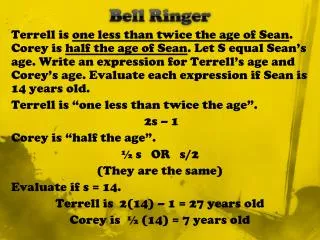
Bell Ringer Terrell is one less than twice the age of Sean. Corey is half the age of Sean. Let S equal Sean’s age. Write an expression for Terrell’s age and Corey’s age. Evaluate each expression if Sean is 14 years old. Terrell is “one less than twice the age”. 2s – 1 Corey is “half the age”. ½ s OR s/2 (They are the same) Evaluate if s = 14. Terrell is 2(14) – 1 = 27 years old Corey is ½ (14) = 7 years old
Quiz: Wednesday Quiz will cover: Writing Expressions Simplifying Expressions Evaluating Expressions The Distributive Property We will review all of the skills tomorrow!
The Distributive Property Again…
Example 1 3(x + 5) We will distribute the 3 to ALL of the terms inside the parentheses. 3(x + 5) (3•x) + (3•5) 3x + 15
Example 2 7(2x – 3) (7•2x) + (7•-3) 14x + (-15) 14x – 15
Example 3 x(2x + 4) (x•2x) + (x•4) 2x2 + 4x
Example 4 5(x2 + 2x – 3) (5•x2) + (5•2x) + (5• -3) 5x2 + 10x + (-15) 5x2 + 10x – 15
Example 5 -2(2x2 – 4x + 9) (-2•2x2) + (-2•-4x) + (-2•9) -4x2+ 8x + (-18) -4x2+ 8x – 18
Evaluating Expressions Again…
Example #1 Evaluate: -2x – 3, if x = 3 Replace “x” with 3 and calculate. -2(3) – 3 -6 – 3 -9
Example #2 Evaluate: -x + 9, if x = -2 -(-2) + 9 2 + 9 11
Example #3 Evaluate: x2 – 3x + 6, if x = 5 (5)2 – 3(5) + 6 25 – 15 + 6 10 + 6 16
Example #4 Evaluate: -4x2 + 8x – 18, if x = -2 -4(-2)2+ 8(-2) – 18 -4(4) + 8(-2) – 18 -16 + (-16) – 18 -32 – 18 -50
Example #5 Evaluate: 3xy – 2x, if x= -3 and y=4 3(-3)(4) – 2(-3) -9(4) – 2(-3) -36 – (-6) -30
Put it together… Simplify and evaluate for x = -2 and y = 4 -2(2x + y) -4x + (-2y) -4(-2) + (-2)(4) 8 + (-8) 0 Distributed!!