Download
1 / 7
70 likes | 211 Views
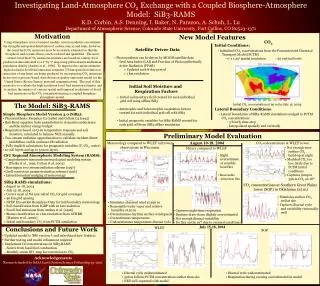
We have developed a coupled biosphere and lower atmosphere model (CAB) and have validated it using surface flux data from eddy covariance towers in the BOREAS study without any model tuning against fluxes. The CAB model has been rigorously tested against surface flux and atmospheric profile data, incorporating variables such as albedo, latent heat, and CO2 concentration. Current and future work includes Bayesian inversion studies to determine land surface exchanges from atmospheric data, and sensitivity analyses to understand atmosphere-biosphere coupling and feedback mechanisms.

E N D
Coupled atmosphere biosphere modelling TH, MW, JM, FIW
Coupled modelling • We have created a coupled model of the biosphere and lower atmosphere (CAB) • We have tested the biosphere model against surface flux data from eddy covariance towers in the BOREAS study – no model tuning against fluxes was undertaken. • We have tested the CAB model against surface flux and atmospheric profile data
(ii) CAB model (i) Off-line biosphere model Planetary Boundary Layer model Albedo, LE, Sens. heat, Ts, Evaporation, Transpiration NEP Wind speed, Air temp., PAR, Precipitation, VPD, CO2 conc. Met. data Biosphere model Biosphere model Respiration model Respiration model Model Comparison Model Comparison Flux data Aircraft data, Stand data
SPA Data CAB
Potential Temperature Moisture content [CO2]
Current work & next steps • Bayesian inversion studies to infer land surface exchanges from e.g. atmospheric profile data (now online from UoE aircraft, see next slide) • Sensitivity analyses on atmosphere-biosphere coupling and feedbacks • Using tall tower data to infer regional C sink strength