Download
1 / 7
70 likes | 277 Views
This guide provides an in-depth look at double object pronouns in Spanish, focusing on both direct and indirect object pronouns. Learn how to correctly use pronouns like me, te, lo, la, nos, and les, especially in sentences that require both direct and indirect objects. Discover the transformations that occur with verbs such as recomendar, dejar, pedir, servir, and dar, and understand the rules for when to use 'se' with indirect object pronouns in conjunction with direct object pronouns. Mastering these concepts will enhance your Spanish fluency.

E N D
Double Object Pronouns Direct Object pronouns + Indirect Object pronouns
Direct Object Pronouns Me Te Lo/La Nos Os Los/Las
Indirect Object Pronouns Me Te Le Nos Os Les
Double Object Pronouns Some verbs such as Recomendar, Dejar, Pedir, Servir, Traer, Llevar, and Dar can have a direct object and an indirect object. Remember to use the indirect object pronoun whenever there is an indirect object. El meseronosrecomendó (a Leli y a mí) el plato del día.
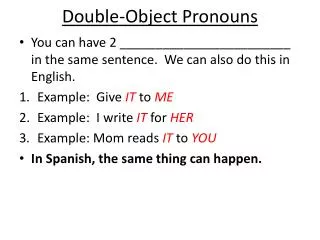
Double Object Pronouns When you use a direct and an indirect object pronoun together, the indirect object pronoun always comes first. Change the indirect object pronouns (le/les) to (se) when used in the same sentence with lo/la/los/las. Changes to ¿Ledejaron la propinaal mesero? Sí, yaseladejamos.
Double Object Pronouns When you use two object pronouns together, the direct object pronoun will usually be lo, la, los, or las. Necesitamospagarla cuenta. ¿Puedetraérnosla, por favor?