
Investigating Calcium Signaling and Its Role in Cardiac Function and Apoptosis
E N D
Presentation Transcript
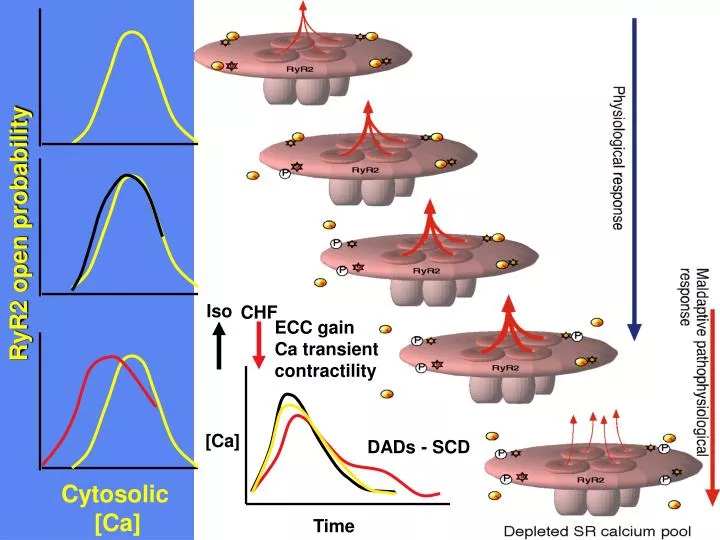
RyR2 open probability Iso CHF ECC gain Ca transient contractility [Ca] DADs - SCD Cytosolic [Ca] Time
Excitation-secretion coupling Inositol 1,4,5-trisphosphate receptors
Stable transfectant Jurkat T cells do not express IP3R1 IP3R1
Calcium signaling during apoptosis Growth Factor Plasma Membrane PIP2 Rec PLC- g Cytoplasm P IP3 14-3-3 P 2+ ER Bad Ca Bad B c l - 2 Degradation IP3R S ERCA 2+ Akt Ca + X ? Calcineurin Cytosolic T F B c l - 2 B c l - 2 B c l - 2 Bad DNA CAD Bcl-x Digestion Nuclear Caspases TF M M Cytochrome C Nucleus Cytoskeletal Breakdown Survival Survival Cell Death
NCE mM [Ca] mitochondria nAChR CNG VDAC Stretch receptor Endoplasmic reticulum mM [Ca] PMCA IP3R SERCA 100 nM [Ca] T-tubule mM [Ca] Sarcoplasmic reticulum VGCC RyR SERCA