Exploring the Properties and Applications of Polymers: A Comprehensive Overview
This seminar, presented by Jon Valasek from St. Marks School of Texas and Debbie Goodwin from Chillicothe High School, delves into the fascinating world of polymers. Attendees will learn about the history, classification, and various properties of polymers, including thermoplastics and thermosets. The session emphasizes hands-on experiments and demonstrations to engage participants, particularly educators looking to enhance their curriculum in materials science. Join us to uncover the science behind these vital materials and their everyday applications.

Exploring the Properties and Applications of Polymers: A Comprehensive Overview
E N D
Presentation Transcript
Polymers - Part 2 Properties
Presenters Jon Valasek • St. Marks School of Texas • Dallas • valasekj@smtexas.org Debbie Goodwin • Chillicothe High School • Chillicothe, MO • nywin@hotmail.com
Polymer Ambassadors www.polymerambassadors.org Mission Statement: The Polymer Ambassadors, with resources from educational,industrial, and professional societies, promote polymer educationwith teachers, students, and community audiences.
Materials Science Teacher Camps • Sponsored by ASM International Foundation • http://www.asminternational.org • Click on “Foundation” tab • Click on “Materials Camp” tab • One week in the summer • No cost
MST Summer Camps • Albuquerque, NM Eldorado High School June 12 - 16 • Ann Arbor, MI U of Michigan July 17 - 21 • Calgary, Canada S Alberta Institute Tech August 21 - 25 • Charlotte/Monroe Wingate University June 19 - 23 • College Park, MD U of Maryland June 27 - 30 • Columbus, OHOhio State University TBA • Dallas, TXUniversity of TexasJuly 17 - 21 • Denver, CO Colorado School of Mines June 26 - 30 • Edmonds, WA Edmonds Community College July 17 - 21 • Edmonton, Canada University of Alberta July 24 - 28 • Gainesville, FL U of Florida June 26 - 30 • Houston, TX U of Houston June 26 - 30 • Long Beach, CA California State University July 10 - 14 • Piscataway, NJ Rutgers UniversityAugust 7 - 11 • Toronto, Canada University of Toronto August 14 – 16 • Youngstown, OH Youngstown State University July 17 - 21
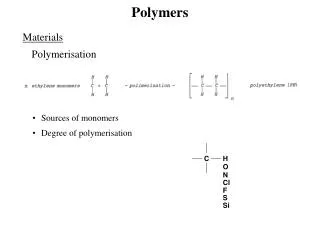
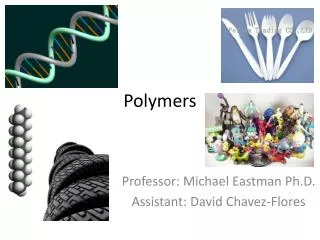
Polymers • Poly – many • Mer - parts • Long chain molecules made of many smaller repeating units
Brief History of Polymers • How old are they? • Why do we use them? • Serendipity books
Polymers • Timeline of Plastics • 1868 Cellulose Nitrate • 1900 Viscose Rayon • 1909 Phenol-Formaldehyde • 1927 Cellulose Acetate • 1933 Polyethylene • 1936 Acrylic or Polymethyl Methacrylate • 1938 Polystyrene • 1939 Nylon • 1941 Polyethylene Terephthalate • 1942 Low Density Polyethylene • 1942 Unsaturated Polyester • 1957 Polypropylene • 1964 Polyimide • 1970 Thermoplastic Polyester • 1978 Linear Low Density Polyethylene • 1985 Liquid Crystal Polymers
Classification • Natural vs. Synthetic • Type of Polymerization • Addition • Condensation • Response to Heat • Thermoplastics • Thermosets
Packing Peanuts • Polystyrene • Starch • Science Lessons • Flex • Compression • Density • Burn • Solubility
Polymer Powders • Water lock • Hydrophilic • Instant Snow • Hydroscopic crosslink • HDPE Powder • Hydrophobic • Gel Crystals • Hydroscopic with semi-permeable cover
Water Loc vs. HDPE • Draw 2 circles on the filter paper • Place Water Loc powder in the center of one circle • Place the same amount of HDPE powder in the center of the other circle • Slowly add drops of water to each powder until the water reaches the edge of the circle
HDPE vs. LDPE • Linear vs. branching • Density • Amorphous vs. crystallinity • Optical properties • Demo – HDPE bottle and heat gun
Elasticity vs. Plasticity • Elastic – returns to its original shape after being distorted by a stress • Rubber ball • Elastic in a waistband • Plastic – retains new shape after being distorted by a stress • Mud ball • Saran wrap
Polymers • Thermoplastic • Melts with heat • Thermoset • Sets with chemical reaction • Elastomer • Is elastic
Additional Labs & Demos • Polydensity tubes • Fibers • Polarizing film and stress • Happy/sad balls • Others……………………