Download
1 / 14
140 likes | 262 Views
This section explores the Enlightenment, a period marked by significant philosophical advancements that challenged established norms such as divine right rule and rigid class systems. The effects of the Enlightenment on arts, music, literature, and governance are highlighted, showcasing the transition from grand Baroque styles to intimate Rococo art, the emergence of operas and novels, and the rise of enlightened despots who embraced reform yet maintained authority. Overall, the Enlightenment's impact reached beyond the elite, even as many peasants remained unaffected by these sweeping changes.

E N D
Chapter 5 Section 2Enlightenment Ideas Spread Mr. Bellisario Woodridge High School First Period World History August 29 & 30, 2013
Prior to the Enlightenment, no one questioned… • Divine right rule • Class systems • Belief in going to heaven b/c of earthly suffering
Enlightenment Effect on Arts(Courtly Art) Baroque • A grand and complex artistic style, during Louis XIV’s rule, early 1700’s • Huge colorful paintings • Glorified battles & Roman Catholic saints
Enlightenment Effect on Arts(Courtly Art) Rococo More personal art Elegant, charming & delicate
Enlightenment Effect on Arts(Middle class audience – merchants & town officials) • Wanted self-portraits without frills, family life in town or country setting • Rembrandt • Dutch artist • Gave dignity to middle-class subjects
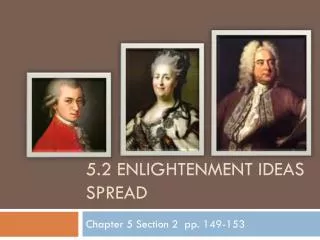
Trends in music • Operas & ballets • Plays put to music • Orderly & structured • Opera houses opened • Johann Bach • Complex & beautiful • Religious works for organ & choir • George Handel – most famous for the “Messiah” • Mozart
Novels (wrote about the common folk) • Daniel Defoe – (Robinson Crusoe) – adventures of shipwrecked sailor • Samuel Richardson – (Pamela) – story about servant girl
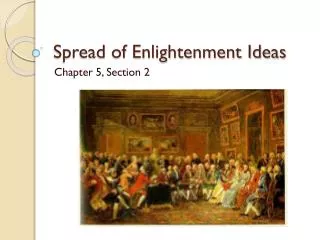
Salons • Social gatherings where artists & thinkers exchange ideas. • Began by women, poetry readings.
Lives of the majority were unaffected by the Enlightenment, especially peasants who lived in small villages • Some peasants worked on patches of land • Tenant farmers paid yearly rents, showed little or no profit • Day laborers hired themselves out to work other’s farms • In France peasants had to provide free labor, building roads & bridges • In England peasants had to allow lords to fox hunt on their land, fields ripped up, crops destroyed
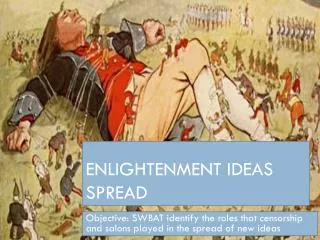
Censorship • Restricting people from hearing or reading about new ideas or new information • Old order was supposedly set up by God – Roman Catholic church leaders & government felt they had to protect people from new ideas • Banned books • Put writers in prison
Enlightened Despots • Rulers who accepted Enlightened ideas & brought about reforms to their nations • However, they never attempted to give-up their power.
Enlightenment Despots Catherine the Great (Russia) • Exchanged letters with Diderot & Voltaire • Limited reform • Spoke out against serfdom (farmers who worked for nobles & had no rights)
Enlightenment DespotsFredrick the Great • Listened to & reads Voltaire who built Prussian Academy of Science • Had agricultural reforms • Drained swamps • New crops like potatoes • Gave seed & tools to peasants who suffered in Prussian wars • Tolerated religious differences, said “everyone can go to heaven in his own fashion” • Reorganized civil service, simplified laws
Enlightenment DespotsJoseph II • Most radical • Traveled in disguise among subjects to learn of their problems, called “Peasant Emperor” • Gave religious toleration to Protestants & Jews in Catholic Austria • Sold monasteries & convents, used proceeds to build hospitals • Abolished serfdom • Ended censorship