Download

1 / 11
110 likes | 248 Views
This guide explores the fundamental concepts of density, mass, and volume, including how these properties are measured and why they are essential for identifying substances. It illustrates that mass is the amount of matter in an object, while volume refers to the space occupied by that matter. Density, a characteristic property, reveals differences between substances and is independent of size or shape. The guide provides practical examples on measuring density for regular and irregular solids, liquids, and gases, alongside relevant questions for comprehension.

E N D
Key Terms • Mass – the amount of matter in an object/substance • Volume – the amount of space matter takes up • Density – the amount of matter/mass in a given space • Weight – the measure of gravity on mass
Possible Questions: • Mass is the amount of ___________ in an object. • What is the amount of space an object takes up? • Density is the amount of ___________ in a given space. • Weight is the measure of ____________ on mass.
Characteristic Properties • The three criteria required: • Measurable • Cannot depend on size, shape, or amount • Show differences between substances • Three must be the same to prove two substances the same • Density IS a characteristic property • Measured in g/cm3 • Doesn’t depend on amount (we know this because the size of alka seltzer tablet did not determine the density of the gas) • Shows differences between substances because each block in the density experiment had a different density.
Possible Questions: • Name the three criteria that are required for a characteristic property. • How many characteristic properties must be proved the same to identify an unknown substance? • How is density a characteristic property?
Measuring Density • Density of Regular Solid • Mass – on a triple beam balance • Volume – multiple length x width x height • Density of an Irregular Solid • Mass – on a triple beam balance • Volume - displacement • Density of a Liquid • Mass – on a triple beam balance • Density of a Gas
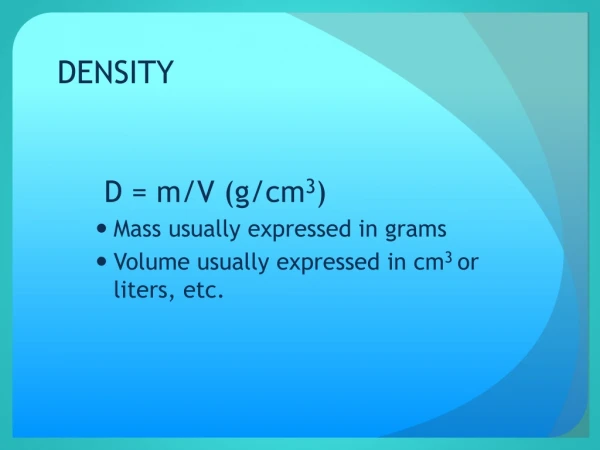
Finding Density • D = m/v • m = D x V • V = m/D
Units • Mass is measured in grams • Volume is measured in: • Solid in cm3 • Liquid in ml • Gas in cm3 • Density is measured in: • Solid in g/cm3 • Liquid g/ml • Gas g/cm3
Possible Questions: • True/False – Solid volume is measured in liters. • True/False – Mass is measured in cm3. • True/False – Density of a liquid is measured in g/ml. • True/False – Density of a gas is measured in g/ml.
Possible Questions • A substance has a mass of 50 grams and a volume of 10 ml. What is the density? • A substance has a volume of 115 ml and a density of 0.5 g/ml. What is the mass? • A substance has a mass of 150 grams and a density of 0.1 g/ml. What is the volume? • A cube has a side of 2.0 cm and a mass of 16 g. What is the density?
Analysis • Name the substances that would float on water. • Which substance is more dense than aluminum but less dense copper? • Which substance has a mass of 174 grams in 100 cm3?