Conventional Encryption Message Confidentiality
This presentation by Henric Johnson from Blekinge Institute of Technology explores the essential aspects of conventional encryption. It covers the fundamental principles, key algorithms, and operational modes of ciphers. Key topics include the importance of secrecy in key distribution, the structure of Feistel ciphers, and various symmetric block cipher systems such as DES and Triple DEA. The discussion emphasizes security parameters like block size, key length, and the number of rounds in encryption algorithms, offering insights for both beginners and professionals in the field of cryptography.


Conventional Encryption Message Confidentiality
E N D
Presentation Transcript
Conventional Encryption Message Confidentiality Henric Johnson Blekinge Institute of Technology, Sweden http://www.its.bth.se/staff/hjo/ henric.johnson@bth.se Henric Johnson
Outline • Conventional Encryption Principles • Conventional Encryption Algorithms • Cipher Block Modes of Operation • Location of Encryption Devices • Key Distribution Henric Johnson
Conventional Encryption Principles • An encryption scheme has five ingredients: • Plaintext • Encryption algorithm • Secret Key • Ciphertext • Decryption algorithm • Security depends on the secrecy of the key, not the secrecy of the algorithm Henric Johnson
Conventional Encryption Principles Henric Johnson
Cryptography • Classified along three independent dimensions: • The type of operations used for transforming plaintext to ciphertext • The number of keys used • symmetric (single key) • asymmetric (two-keys, or public-key encryption) • The way in which the plaintext is processed Henric Johnson
Average time required for exhaustive key search Henric Johnson
Feistel Cipher Structure • Virtually all conventional block encryption algorithms, including DES have a structure first described by Horst Feistel of IBM in 1973 • The realization of a Fesitel Network depends on the choice of the following parameters and design features (see next slide): Henric Johnson
Feistel Cipher Structure • Block size: larger block sizes mean greater security • Key Size: larger key size means greater security • Number of rounds: multiple rounds offer increasing security • Subkey generation algorithm: greater complexity will lead to greater difficulty of cryptanalysis. • Fast software encryption/decryption: the speed of execution of the algorithm becomes a concern Henric Johnson
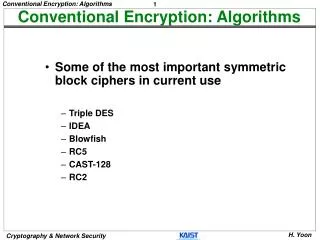
Conventional Encryption Algorithms • Data Encryption Standard (DES) • The most widely used encryption scheme • The algorithm is reffered to the Data Encryption Algorithm (DEA) • DES is a block cipher • The plaintext is processed in 64-bit blocks • The key is 56-bits in length Henric Johnson
DES • The overall processing at each iteration: • Li= Ri-1 • Ri = Li-1 F(Ri-1, Ki) • Concerns about: • The algorithm and the key length (56-bits) Henric Johnson
Time to break a code (106 decryptions/µs) Henric Johnson
Triple DEA • Use three keys and three executions of the DES algorithm (encrypt-decrypt-encrypt) • C = ciphertext • P = Plaintext • EK[X] = encryption of X using key K • DK[Y] = decryption of Y using key K • Effective key length of 168 bits C = EK3[DK2[EK1[P]]] Henric Johnson
Triple DEA Henric Johnson
Other Symmetric Block Ciphers • International Data Encryption Algorithm (IDEA) • 128-bit key • Used in PGP • Blowfish • Easy to implement • High execution speed • Run in less than 5K of memory Henric Johnson
Other Symmetric Block Ciphers • RC5 • Suitable for hardware and software • Fast, simple • Adaptable to processors of different word lengths • Variable number of rounds • Variable-length key • Low memory requirement • High security • Data-dependent rotations • Cast-128 • Key size from 40 to 128 bits • The round function differs from round to round Henric Johnson
Cipher Block Modes of Operation • Cipher Block Chaining Mode (CBC) • The input to the encryption algorithm is the XOR of the current plaintext block and the preceding ciphertext block. • Repeating pattern of 64-bits are not exposed Henric Johnson
Location of Encryption Device • Link encryption: • A lot of encryption devices • High level of security • Decrypt each packet at every switch • End-to-end encryption • The source encrypt and the receiver decrypts • Payload encrypted • Header in the clear • High Security: Both link and end-to-end encryption are needed (see Figure 2.9) Henric Johnson
Key Distribution • A key could be selected by A and physically delivered to B. • A third party could select the key and physically deliver it to A and B. • If A and B have previously used a key, one party could transmit the new key to the other, encrypted using the old key. • If A and B each have an encrypted connection to a third party C, C could deliver a key on the encrypted links to A and B. Henric Johnson
Key Distribution (See Figure 2.10) • Session key: • Data encrypted with a one-time session key.At the conclusion of the session the key is destroyed • Permanent key: • Used between entities for the purpose of distributing session keys Henric Johnson
Recommended Reading • Stallings, W. Cryptography and Network Security: Principles and Practice, 2nd edition. Prentice Hall, 1999 • Scneier, B. Applied Cryptography, New York: Wiley, 1996 • Mel, H.X. Baker, D. Cryptography Decrypted. Addison Wesley, 2001 Henric Johnson