Lesson 2: Scientific Method and Measurements
130 likes | 447 Views
Lesson 2: Scientific Method and Measurements. Scientific method Controlled experiments Early measurements U.S. Conventional System Metric (SI) units Temperature Common Measurements in Aquaponics. What are the components of the scientific method?. Observation


Lesson 2: Scientific Method and Measurements
E N D
Presentation Transcript
Lesson 2: Scientific Method and Measurements Scientific method Controlled experiments Early measurements U.S. Conventional System Metric (SI) units Temperature Common Measurements in Aquaponics
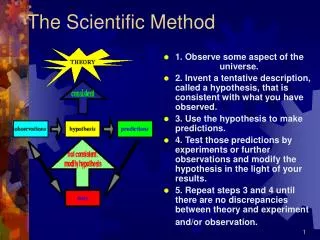
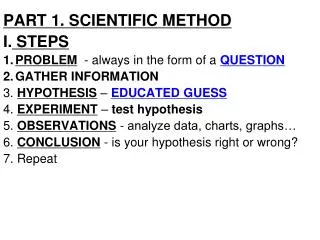
What are the components of the scientific method? • Observation • An observation is made regarding some event or characteristic of the world around us • Hypothesis • A guess to find an answer to the observation • Experimentation • The method to prove or disprove the hypothesis • Conclusion • The findings of the experiment
Controlled Experiments • Designed to test a hypothesis • Carefully planned • Consists of two groups • Test group • Control group
Early Measurements • Based on the sizes of ordinary objects • foot = length of a mans foot, heel to toe • Yard = distance of nose to tip of out stretched thumb • Accurate or not?
United States Conventional System • Fluid Volume • Teaspoon, tablespoon, fluid ounce, cup, pint, quart, gallon, bushel, barrel • Weight • Gram, ounce, pound, short hundredweight, short ton, quintal, long ton • Linear Measurement • Inch, foot, yard, mile, furlong, rod, nautical mile • Cubic Measurement (volume) • Cubic inch, cubic foot, cubic gallon, cubic yard • Square Measurement (area) • Square inch, square mile, square yard, square acre, square mile • Power and efficiency • Slug, foot pound, horsepower
Metric System (System International) • Fluid Volume • Milliliter, centiliter, deciliter, liter, dekaliter, hectoliter, kiloliter • Weight • Milligram, centigram, decigram, gram, dekagram, hectogram, kilogram • Length • Millimeter, centimeter, decimeter, meter, dekameter, hectometer, kilometer • Cubic Measurement (Volume) • Cube everything in length • Square Measurement (Area) • Square everything in length
Temperature • The temperature scale used in the United States is Fahrenheit but, worldwide and in most sectors of the scientific community Celsius is used. When discussing absolute temperature, Kelvin is used • Conversions = • C = 5/9(F-32) • F = (9/5C)+32 • K = C + 273.16
Common Measurements in Aquaponics • Dry and Liquid Weights • Fish food • Plant fertilizer • Water conditioner • pH adjusting chemicals • Weight of plants when introduced to system • Weight of plants at harvest • Weight of fish when introduced to system • Weight of fish at harvest
Common Measurements in Aquaponics • Fluid Volume • Total volume of water in tank • Amounts removed and added during water changes or maintenance.
Common Measurements in Aquaponics • Linear Measurements • Length, width of plants introduced to system • Length, width of plants at harvest • Length, width of fish at introduction to system • Length, width of fish at harvest
Common Measurements in Aquaponics • Area • Size of grow bed for plants • Temperature • Using thermometers, one submersible for fish tank • Water temperature • Air temperature
Activity • You are to perform the problems given on the worksheet in groups of 2. • Once finished with the worksheet, you are each, as individuals to develop a theory based on observation about the ecosystem and symbiotic relationships in the Aquaponics system. Write this on the back of your worksheet.