Download
1 / 3
30 likes | 151 Views
This overview highlights significant contributions to the field of Artificial Intelligence (AI) from 1994 onwards, featuring the influential Turing Award lectures by Edward Feigenbaum and Raj Reddy. It includes pivotal research papers on traditional clustering, reinforcement learning, shape-based image retrieval, and spatio-temporal data mining. Key publications such as Page and Brin's work on PageRank and other significant studies that illustrate advancements in AI methodologies are discussed. This collection serves as a resource for understanding the evolution of AI techniques and their applications.

E N D
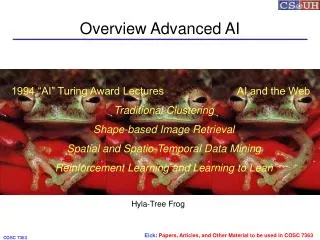
Overview Advanced AI 1994 “AI” Turing Award Lectures AI and the Web Traditional Clustering Graph & Sequence Mining Shape-based Image Retrieval Spatial and Spatio-Temporal Data Mining Reinforcement Learning and Learning to Learn Hyla-Tree Frog
Paper Reading List COSC 7363 • AI through 1995: Edward Feigenbaum’s and Raj Reddys 1994 Turing Award Lectures in CACM, May 1996.. • Page & Brin (Google Publication), The PageRank Citation Ranking: Bringing Order to the Web, 1998; walkthrough paper; perhaps this is a better source of the work: Page & Brin (Google Publication), The Anatomy of a Large-Scale Hypertextual Web Search Engine,1999. • CV of Sergey Brin & potcast of 2005 Interview with Sergey Brin (http://www.itconversations.com/shows/detail795.html) • Hanghang Tong, Christos Faloutsos, and Jia-Yu Pan, Fast Random Walk with Restart and Its Applications, Proc. ICDM Conference, Hong Kong, China, Dec. 2006; won best research paper award; 2 student-supervised walkthrough • Langville & Meyer, Deeper Inside Page Rank, Internet Mathematics, Vol. 1, No. 3, 335-380, 2004; potential student presentation paper • 3 page IEEE Survey Paper on Search Engines • Original DBSCAN Paper; 2-student-supervised walkthrough • Rousseaux Original Silhouette Paper; • A. Smith, The Task of the Referee, IEEE Computer, Vol. 23, No. 4, April 1990
Paper Reading List COSC 7363 • Cyrus Shahabi, Maytham Safar, An experimental study of alternative shape-based image retrieval techniques, Multimedia Tools and Applications, Springer Netherlands, November 2006. • S. Shekhar, P. Zhang, Y. Huang, R. Vatsavai, Trends in Spatial Data Mining, Chapter3 ofData Mining: Next Generation Challenges and Future Directions, H. Kargupta, A. Joshi, K. Sivakumar, and Y. Yesha(eds.), AAAI/MIT Press, 2003. • CHAMELEON and CLUTO (http://glaros.dtc.umn.edu/gkhome/cluto/cluto/overview) • Co-location Mining with Rare Spatial Featuresby Yan Huang, Jian Pei, and Hui Xiong published in Journal of GeoInformatica, vol. 10, issue 3,2006. • Mirco Nanni, Dino Pedreschi.Time-focused density-based clustering of trajectories of moving objects.in Journal of Intelligent Information Systems (JIIS), 27(3):267-289, 2006. • H. Cao, N. Mamoulis, and D. W. Cheung, "Discovery of Periodic Patterns in Spatiotemporal Sequences," IEEE Transactions on Knowledge and Data Engineering (TKDE), to appear. • Reinforcement Learning: A Survey byKaelbling, L. P. and Littman, M. L. in JAIR, 1996 (http://www.cs.cmu.edu/afs/cs/project/jair/pub/volume4/kaelbling96a-html/rl-survey.html ) • Daniel Saunders, Paul Thagard, Creativity in Computer Science, In J. C. Kaufman & J. Baer (Eds.), Creativity across domains: Faces of the muse. Mahwah, NJ: Lawrence Erlbaum Associates.