
Understanding Radioactive Dating: Essentials and Methodology for Reliable Results
Radioactive dating relies on four critical components: a known decay scheme with accurate half-lives, reliable measurements of specific isotopes, a convincing argument for the starting point of decay, and a useful age range for the technique. Key isotopes include Carbon-14 and Uranium-238, each with unique decay pathways. Measurements can be obtained via beta activity counting and mass spectrometry. It's crucial to understand these fundamentals to avoid misinterpretation, especially when dating older specimens beyond the technique's effective range.

Understanding Radioactive Dating: Essentials and Methodology for Reliable Results
E N D
Presentation Transcript
Four Essentials Must find or know each of these in order to use radioactive dating (reliably)! • 1—decay scheme with known 1/2-lives • 2—NOW! a reliable measurement of two numbers (or one ratio) • 3—THEN! a compelling argument for values of those numbers (or that ratio) when the clock “started” • 4—useful range of ages for assumed technique
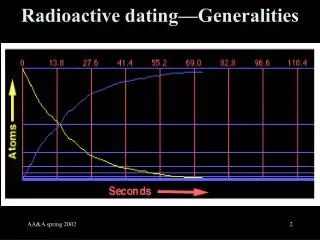
Radioactive decay: known 1/2-life More precisely, a known time dependence • C14—5568 versus 5730 years • U238 —> Th230 —> Pb206 • More complex—long chain • Many 1/2 lives involved • BUT we know and understand the scheme
Radioactive decay: known 1/2-life More precisely, a known time dependence • O21 —> F21 —> Ne21 • More complex—short chain • Two 1/2 lives involved • BUT we know and understand the scheme!
NOW! Reliable measurement two numbers or a ratio C14 dating— • counting technique: • C14 from beta activity (counting rate) • C12 from weight of sample • ASM (accelerator mass spectrometry) • C14 and C12 from the mass spectrometer • U238 —> Th230 —> Pb206 • U238 and Th 230 from alpha spectroscopy OR • Mass spectrometry
THEN! Starting the clock compelling argument for initial values of those numbers (or that ratio) • C14 dating • All that stuff about generation of C14, atmospheric mixing, incomplete mixing in ocean, local high concentrations of “dead carbon,” … • U238 —> Th230 —> Pb206 • No Th in sea water bathing the corals: only U • No Th in seepage water as limestone cave formations develop: only U
Starting the clock C14—drops by 1/2 every 5730 years: t = T1/2 log2 (R0/Rt) U238/Th230—complicated but calculable
Useful range of ages? • Critical parameter is some half-life! • Works “best” at ages ~T1/2 • 6,000 years for C14 • 75,000 years for U238/Th 230 • In trouble for ages > ~(6-10) T1/2 • The exponential decay is hard to fight against • In trouble for ages < ~[(1-few)/100] T1/2 • Depends on details of decay scheme and method
Must: • Know the nuclear physics • Measure two numbers now or (or one ratio) • Know how the clock started? • Not to try to date 150,000 years with C14