Download
1 / 11
110 likes | 227 Views
Dive into the fascinating world of color theory, where we explore how colors interact and affect our perception. Discover the basics of color, including primary, secondary, and tertiary colors, and learn about hue, tint, and shade. Understand the science behind color perception through the roles of rods and cones in the retina and the optic nerve. Explore various color schemes such as monochromatic, complementary, warm, and cool colors, and learn how to apply these principles in art projects. Engage with design principles to enhance your artistic creations.

E N D
Color Theory “It's all very well and good discussing individual colors, but we very rarely see colors by themselves. We see them with other colors and colors change according to their environment.”
The science of color • Color is not always equal • The eye and the mechanics • Rods & Cones • Retina • Optic Nerve
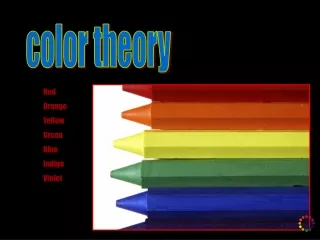
The Science of Color • Do we see all colors • Roy G Biv-Red, Orange, Green, Blue, Indigo, Violet
The Science of color Color is only what is reflected back to us
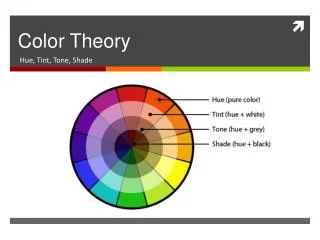
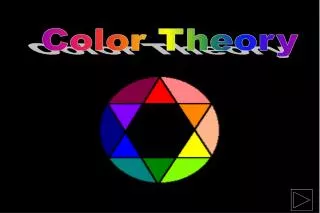
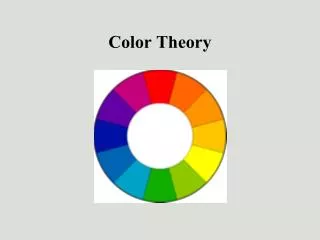
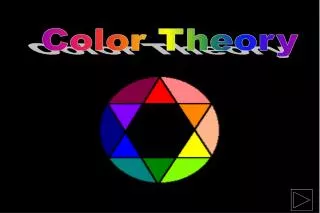
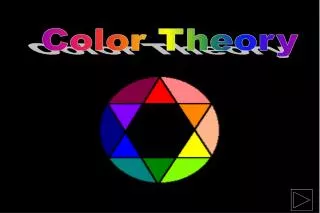
Tertiary/ Intermediate Secondary Colors Color Primary colors Hue- is the same as color Tint- is lightened color, white + color Shade- is darkened color, black + color
Color Schemes • Monochromatic-self-portrait, one color and its values
Color Schemes • Complementary-colors opposite each other on the color wheel
Color Schemes • Warm-colors of the sun and fire, reds and yellows and oranges
Color Schemes • Cool-colors of snow and ice, blues, greens and purples
Panels can be Realistic Abstract Color Scheme Art Project • Create an artwork that will be separated into three areas for three different color schemes
Examples of ways to approach this assignment in design Remember to think about the principles of design.