Download
1 / 10
100 likes | 228 Views
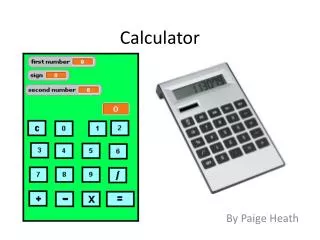
This Excel-based calculator is designed to obtain values for the Nusselt number and convective coefficient for fluids and liquid metals flowing in a circular tube. Utilizing methods from section 8.5 of the referenced textbook, users can easily input their flow data and conditions to receive results. The calculator allows for a selection of different methods, enabling efficient analysis with immediate feedback (green for good results, red for bad). Ideal for thermal engineers and students, this tool streamlines the calculation process and improves accuracy.

E N D
Internal Flow Calculator Melissa Armstrong Micah Christiansen
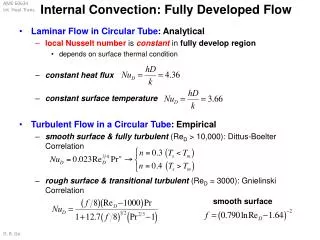
Objective Create a calculator to obtain values of the Nusselt number and convective coefficient for fluids and liquid metals inside a circular tube using the methods found in section 8.5 (Dittus, Sieder, Gnielinski, Skupinski, and Seban) .
Using the Calculator • Open Excel file • Enable Macros • Select which method to use • Input all data in the method box you selected • Select conditions in the orange box • Press Run • Read Results (Green-Good, Red-Bad)
Example Water at a flow rate = 0.215 kg/s is cooled from 70⁰C to 30⁰C by passing it through a thin-walled tube of diameter D = 50 mm and maintaining coolant at 15⁰C in cross flow over the tube. Find the convective coefficient (h) for the interior of the tube.
Example We can find the following properties for water at our average temperature (323 K) and surface temperature (298 K).
Example We can now select the appropriate method (Method 2 in this case) and input our data.
Example Now we select the conditions (in this example we are cooling a fluid) and hit run.
Example We can now read our results and select the appropriate (green) Nusselt number and convective coefficient.
Recommendations When calculating the Nusselt number or convective coefficient for the internal flow of a circular tube, use the calculator (rather than doing the work by hand) to save time.
Appendix Fundamentals of Heat and Mass Transfer by Incropera, DeWitt, Bergman, and Lavine, 6th Edition, Section 8.5.