Understanding Bias and Sampling Error in Simple Random Sampling
In this lesson, we explored the concepts of bias and sampling error as discussed in the previous class. We focus on why sampling is crucial, as it helps us gather insights about the population without the extensive time and cost involved in conducting a census. A Simple Random Sample (SRS) ensures that every individual has an equal chance of being selected, making our sample representative. We'll also demonstrate taking an SRS of a class size of 5 using random digit tables or calculators.

Understanding Bias and Sampling Error in Simple Random Sampling
E N D
Presentation Transcript
Do Now:1. Take out HW.2. Copy down HW.3. What are the types of Bias and Sampling Error we discussed last class? Explain what they are.
Ch. 5 Taking a Simple Random Sample SRS Day 1
Why do we sample? -We sample because we want to know something about our population. -We sample because taking a census is often costly and takes a lot of time. -We always want our sample to be representative of our population.
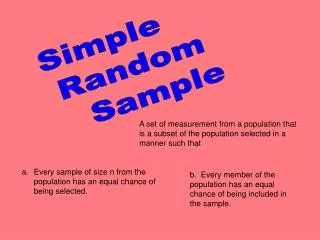
Simple Random Sample (SRS) (Def). A random sample in which every individual and every group of individuals have the same chance of being chosen.
Example 1: Taking an SRS of the Class • Let’s take a sample of size n=5. • Label. • Table (or Calculator)