Effects of Hypoxia on Survival and Growth of Barnacle Larvae Off the Oregon Coast
Effects of Hypoxia on Survival and Growth of Barnacle Larvae Off the Oregon Coast Amanda Amstutz Department of Zoology Dr. Bruce Menge Dafne Eerkes-Medrano Department of Zoology HYPOXIA: Dissolved oxygen concentrations of less than 1.4 ml /L

Effects of Hypoxia on Survival and Growth of Barnacle Larvae Off the Oregon Coast
E N D
Presentation Transcript
Effects of Hypoxia on Survival and Growth of Barnacle Larvae Off the Oregon Coast Amanda Amstutz Department of Zoology Dr. Bruce Menge Dafne Eerkes-Medrano Department of Zoology
HYPOXIA: Dissolved oxygen concentrations of less than 1.4 ml /L • Hypoxia can cause mass die offs of marine life in areas known as DEAD ZONES
Hypoxia off the Oregon Coast • Hypoxia in shallow waters • (50m or less) was first documented • in the summer of 2002 and has • occurred every summer from 2002-2007
A healthy rockfish reef before 2006 anoxia (left) and after 2006 anoxia (right). Hypoxia off the Oregon Coast
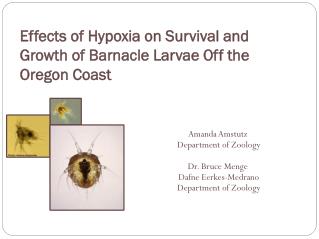
Barnacles! • Barnacles are found on hard substrata in coastal regions • They are filter feeders • Barnacles have a total of eight life stages • Seven of these life stages are open-ocean larval forms www.microscopy-uk.org.uk/mag/imgjan99/naup.jpg
Barnacles are important as: Ecological engineers Prey Because barnacles are ecologically important species, fluctuations in barnacle populations effect entire ecosystems. Photos courtesy Dr. Mark Hixon
Research Goals:1. Determine mortality of larvae at increasingly severe levels of hypoxia for a given exposure period2. Determine if exposure to hypoxic conditions effects growth of larvae Rear barnacle larvae in the laboratory Expose larvae to hypoxia Measure survival Monitor growth and development
Predictions: • Due to the historical lack of hypoxia close to shore, barnacle larvae are predicted to experience high mortality when exposed to hypoxia • Larvae are predicted to experience increased mortality with increasing severity of hypoxia and duration of exposure • Larvae are predicted to have slower growth rates when they have been exposed to hypoxia
Preliminary Results Cumulative mortality of Balanus glandula mixed stage larvae through a six day period after exposure to microxia (0.5 mg/l dissolved oxygen) or normoxia (5 mg/L dissolved oxygen) for 24 hours. (Means ±SD; normoxia n=3; microxia n=3 )
What’s Next • Ensure errors in system have been corrected • Perform 48 and 72 hour trials • Monitor development and growth
Acknowledgements • Howard Hughes Medical Institute • OSU University Honors College • Dr. Kevin Ahern • Dr. Bruce Menge and Dafne Eerkes-Medrano • Hatfield Marine Science Center • Dr. Chris Langdon