Understanding the Basics of Matter: Mixtures, Compounds, and Elements
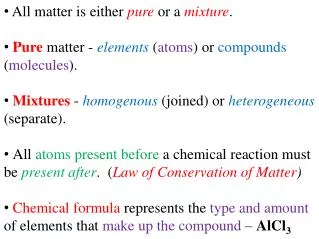
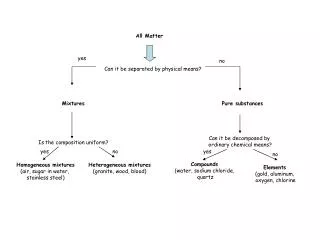
This guide explores the fundamental concepts of matter, detailing the differences between pure substances and mixtures. It examines whether mixtures can be separated by physical means, how pure substances can be decomposed through ordinary chemical methods, and identifies whether compositions are uniform or not. We categorize matter into elements, compounds, homogeneous, and heterogeneous mixtures, providing examples such as water, air, stainless steel, granite, and more. Gain insight into the building blocks of matter.

Understanding the Basics of Matter: Mixtures, Compounds, and Elements
E N D
Presentation Transcript
All Matter yes no Can it be separated by physical means? Mixtures Pure substances Can it be decomposed by ordinary chemical means? Is the composition uniform? yes no yes no Compounds (water, sodium chloride, quartz Homogeneous mixtures (air, sugar in water, stainless steel) Heterogeneous mixtures (granite, wood, blood) Elements (gold, aluminum, oxygen, chlorine