Naming Polyatomic Ions and Acids
60 likes | 186 Views
This guide provides a comprehensive overview of naming polyatomic ions and acids, focusing on oxyanions—negative ions containing oxygen. It explains the distinction between the suffixes “-ate” and “-ite,” where “-ate” indicates more oxygen atoms than “-ite.” The presence of prefixes like "hypo-" and "per-" further clarifies the number of oxygen atoms. Additionally, the guide covers how to name acids based on their composition and whether they contain oxygen, providing essential examples like hydrochloric and sulfuric acids.


Naming Polyatomic Ions and Acids
E N D
Presentation Transcript
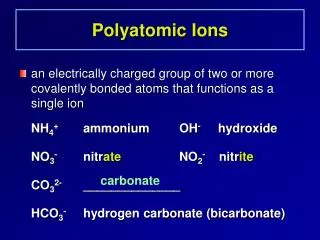
Oxyanions • Oxyanions- negative ions containing oxygen. • These have the suffix “-ate” or “-ite” • “-ate” means it has more oxygen atoms bonded, “-ite” has less • For example • SO42- sulfate • SO32- sulfite
Oxyanions • Oxyanions may contain the prefix “hypo-”, less than, or “per-”, more than. • For example • ClO4- Perchlorate • ClO3- Chlorate • ClO2- Chlorite • ClO- Hypochlorite
Acids • Certain compounds produce H+ ions in water, these are called acids. • You can recognize them because the neutral compound starts with “H”. • For example HCl, H2SO4, and HNO3. • All acids are like ionic compounds but the metal is replaced with H+ • It will be H +halogens or H + polyatomic ions
Naming acids • Does it contain oxygen? • If it does not, it gets the prefix “hydro-” and the suffix “-ic acid” • HCl • Hydrochloric acid • HF • Hydrofluoric acid • HCN • Hydrocyanic acid
Naming Acids • If it does contain an oxyanion, then replace the ending. • If the ending was “–ate”, add “-ic acid” • If the ending was “–ite”, add “-ous acid” • H2SO4 Sulfuric Acid • H2SO3 Sulfurous Acid