Understanding Polyatomic Ions and Naming Acids in Chemistry
Dive into the world of polyatomic ions and acids with this comprehensive guide. Learn how to identify and memorize essential polyatomic ions, and discover the differences between binary acids and oxyacids. Master the systematic approach to naming these acids by following specific rules, such as using prefixes and changing nonmetal endings. Engage in practical exercises that reinforce your understanding of formulas and formula mass. Perfect for chemistry students looking to enhance their knowledge and skills in acid-naming conventions and ion recognition.

Understanding Polyatomic Ions and Naming Acids in Chemistry
E N D
Presentation Transcript
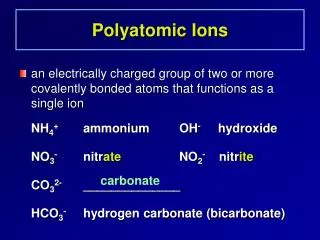
Naming Polyatomic Ions • Didn’t you say we had to memorize these? • Lets look at the polyatomic ions and how they differ!!!
Acids • Acids are molecular compounds that form H+ when dissolved in water • Sour taste • Dissolve many metals • Like Zn, Fe, Mg, but not Au, Ag, Pt. • Formula generally starts with H • E.g., HCl, H2SO4.
Acids, Continued • Contain H+1cation and anion • In aqueous solution • Binary acids have H+1and nonmetal • Oxyacids have H+1and polyatomic
Naming Binary Acids • Write a hydro- prefix. • Follow with the nonmetal name. • Change ending on nonmetal name to –ic. • Write the word acid at the end of the name.
Let’s try a Few • HBr • HF • HI
Practice─Name the Following • H2S • HClO3 • HNO2
Writing Formulas for Acids • When name ends in acid, formulas starts with H. • Hydro- prefix means it is binary acid, no prefix means it is an oxyacid. • For an oxyacid, if ending is –ic, polyatomic ion ends in –ate; if ending is –ous, polyatomic ion ends in –ous.
Practice—What Are the Formulas for the Following Acids? • Chloricacid • Phosphoric acid • Hydrobromic acid
Lets Try a Few!! • Potassium Chloride • Aluminum Oxide • Potassium Sulfide • Magnesium Hydroxide
Lets Try A few • HNO3 • H2SO4 • H2SO3
Formula Mass • The mass of an individual molecule or formula unit • Also known as molecular mass or molecular weight • Sum of the masses of the atoms in a single molecule or formula unit • Whole = Sum of the parts. Mass of 1 molecule of H2O = 2(1.01 amu H) + 16.00 amu O = 18.02 amu.