Exploring the Diverse World of Protists: A Detailed Laboratory Study for BIOL 171
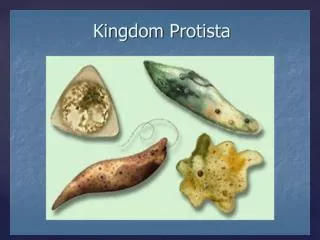
In this BIOL 171 lab, we delve into the fascinating kingdom of Protista, often referred to as "the junk drawer of the eukaryotes." We cover various major groups, including Alveolates, Stramenopiles, Rhizarians, Red Algae, Green Algae, Amoebozoans, and Slime Molds, examining their ecological roles, morphological characteristics, and economic importance. Through hands-on observations of live and preserved specimens, students will learn how these organisms contribute to ecosystems, their evolutionary significance, and their various applications in industry and research.

Exploring the Diverse World of Protists: A Detailed Laboratory Study for BIOL 171
E N D
Presentation Transcript
ProtistsI & II Lab 4 BIOL 171
Saving for next week? We’ll be looking at all of these! Protists are everywhere in Eukarya! “the junk drawer of the eukaryotes” Ancestral Eukaryote
We’ll be looking at all of these! Protists are everywhere in Eukarya! “the junk drawer of the eukaryotes” Ancestral Eukaryote
6 Kingdoms • Plants (Plantae) • Animals (Animalia) • Fungi (Fungi) • Eubacteria • Archaeabacteria • Protista These are considered “qualitative” terms— not correct science terminlogy.
Lab Study A: Alveolates Dinoflagellates: mixed dinoflagellates (live & wet mount), and Peridinium (wet mount) not in manual Apicomplexans: Trypanosoma – prepared slides Ciliate: Paramecium caudatum – (wet mount) in manual
Lab Study B: Stramenopiles Diatoms (Bacillariophyta) – make wet mount Also observe diatomaceous earth (the cell wall deposits from diatoms) – make wet mount and look at prepared slides
Brown Algae (Phaeophyta) Living: Ectocarpus and Sphacelaria Preserved: Fucus and Laminaria
Lab Study C: Rhizaria(different title from manual) • Foraminiferans - prepared slides • Radiolarians – prepared slides
Think about… • Morphological characteristics • Ecology of the organism • How does the organism get around? • What role do they play in the ecosystem? • Do they have any economic value? • Where do they live? • Don’t know the answer?? It’s probably a great research question! Ask me about it.
Protists 2 Laboratory 4 (still) BIOL 171
What is red algae? • Eukaryotic • Photosynthetic • NOT plants • Most are aquatic
Lab Study D: Red Algae (Rhodophyta) • Simplest is single celled, but most have a macroscopic, multicellular body form • Autotrophic(photosynthetic)– manufactures its own organic nutrients from inorganic carbon sources • Contain chlorophyll a and accessory pigments phycocyanin and phycoerythrin • Not all are red! Many green, black, even blue, depending on the depth in the ocean they grow
Preserved specimens Porphyra coralline algae Chondruscrispus
Porphyra life cycleboth sexual and asexual – alternation of generations!
Coralline algae – “living rock” • Extremely important role in the ecology of coral reefs: sea urchins, fish, and mollusks eat them (herbivore enhancement). • Create microhabitats that protect invertebrates from predation. • Cell walls composed of calcium carbonate – this allows it to fossilize • Economic importance: soil conditioners, food additive for livestock, water filtration, medical vermifuge (stopped late in 18th century), preparation of dental bone implants
Economic Uses • Agar – polysaccharide extracted from the cell wall of red algae, used to grow bacteria and fungi • Carrageenan– extracted from red algae cell walls, used to give the texture of thickness and richness to foods such as dairy drinks and soups. • Porphyra(or nori) – seaweed wrappers for sushi, billion-dollar industry!
Lab Study E: Green Algae (Chlorophyta) • unicellular motile and non-motile, colonial, filamentous, and multicellular – GREAT DIVERSITY • Live primarily in freshwater • Share many characteristics with land plants • Storage of starch, presence of chlorophylls a and b, photosynthetic pathways, and organic compounds called flavonoids • Most botanists support the hypothesis that plants evolved from green algae
Living Specimens Volvox Chlamydomonas Pediastrum Closterium Pandorina
Volvox Daughter colonies
Preserved Specimens Ulva Chara
Lab Study F: Amoebozoans Amoeba proteus • Pseudopodia – temporary extensions of amoeboid cells, function in moving and engulfing food
Lab Study G: Slime Molds (Mycetozoa) • Protists which use spores to reproduce • Heterotrophic – requires carbon in organic form, cannot manufacture it’s own • Feed using phagocytosis • Suggests they descended from unicellular amoeba-like organisms • Two types: plasmodial and cellular (we will be observing plasmodial type today)
Physarum(slime mold) • Plasmodial stage – vegetative stage that consists of a multinucleate mass of protoplasm (no cell walls), feeds on bacteria as it creeps along the surface of moist logs or dead leaves • Fruiting bodies – reproductive structures that produce spores
Physarum (plasmodial stage) Is slime mold smarter than Japan's railway engineers?check it out!