Coupling Informatics Algorithm Development and Visual Analysis
Researchers have explored the potential of Transcranial Magnetic Stimulation (TMS) to alleviate hallucinations in schizophrenia patients. In a preliminary study, approximately half of the 12 participants experienced significant reduction in auditory hallucinations after receiving repeated magnetic stimulation to a targeted brain area. This treatment, which provides sensations similar to a "woodpecker knock," showed effects lasting from a few days to several weeks in some patients. Despite encouraging results, researchers emphasize the need for further study to evaluate its efficacy and safety.

Coupling Informatics Algorithm Development and Visual Analysis
E N D
Presentation Transcript
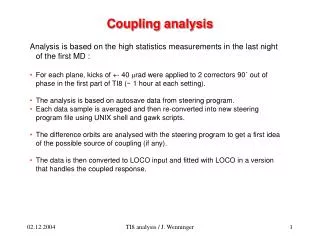
Coupling Informatics Algorithm Development and Visual Analysis Danny Dunlavy, Pat Crossno, Tim Shead Sandia National Laboratories SIAM Annual Meeting July 7, 2008 SAND2008-4470P Sandia is a multiprogram laboratory operated by Sandia Corporation, a Lockheed Martin Company,for the United States Department of Energy’s National Nuclear Security Administration under contract DE-AC04-94AL85000.
<DOC><DOCNO><s docid="APW19990519.0113" num="1" stype="-1">APW19990519.0113</s></DOCNO><DATE_TIME><P> <s docid="APW19990519.0113" num="2" stype="-1"> 1999-05-19 21:11:17</s> </P></DATE_TIME><BODY><CATEGORY><s docid="APW19990519.0113" num="3"stype="-1"> usa</s></CATEGORY><HEADLINE><P> <s docid="APW19990519.0113" num="4" stype="0"> Pulses May Ease SchizophrenicVoices</s> </P></HEADLINE><TEXT><P> <s docid="APW19990519.0113" num="5" stype="1"> WASHINGTON (AP)Schizophrenia patients whose medication couldn't stop the imaginary voices in theirheads gained some relief after researchers repeatedly sent a magnetic field into asmall area of their brains.</s> </P><P><s docid="APW19990519.0113" num="6"stype="1"> About half of 12 patients studied said their hallucinations becamemuch less severe after the treatment, which feels like ``having a woodpeckerknock on your head'' once a second for up to 16 minutes, said researcherDr.Ralph Hoffman.</s> <s docid="APW19990519.0113" num="7" stype="1">The voices stopped completely in three of these patients.</s> </P><P><sdocid="APW19990519.0113" num="8" stype="1"> The effect lasted for up toa few days for most participants, and one man reported that it lasted seven weeksafterbeing treated daily for four days.</s> </P><P><sdocid="APW19990519.0113" num="9" stype="1"> Hoffman stressed that thestudy is only preliminary and can't prove that the treatment would be useful.</s> <sdocid="APW19990519.0113" num="10" stype="1"> ``We need to do much moreresearch on this,'' he said in an interview.</s> </P><P><sdocid="APW19990519.0113" num="11" stype="1"> Hoffman, deputy medicaldirector of the Yale Psychiatric Institute, is scheduled to present the workThursday at the annual meeting of the American Psychiatric Association.</s> </P><P><s docid="APW19990519.0113" num="12" stype="1"> Not all people withschizophrenia hear voices, and of those who do, Hoffman estimated that maybe 25percent can't control them with medications even when other disease symptomsabate.</s> <s docid="APW19990519.0113" num="13" stype="1"> So the workcould pay off for ``a small but very ill group of patients,'' he said.</s> </P><P><sdocid="APW19990519.0113" num="14" stype="1"> The treatment is calledtranscranial magnetic stimulation, or TMS.</s> <s docid="APW19990519.0113"num="15" stype="1"> While past research indicates it mightbe helpful in lifting depression, it hasn't been studied much in schizophrenia.</s> </P><P><s docid="APW19990519.0113" num="16" stype="1"> In TMS, anelectromagnetic coil is placed on the scalp and current is turned on and off to create apulsing magnetic field that reaches into a small area of the brain.</s> <sdocid="APW19990519.0113" num="17" stype="1"> The goal is to make brain cellsunderneath the coil fire messages to adjoining cells.</s> </P><P><sdocid="APW19990519.0113" num="18" stype="1"> The procedure is muchdifferent from electroconvulsive therapy, called ECT, which applies pulses ofelectricity rather than a magnetic field to the brain.</s> <sdocid="APW19990519.0113"num="19" stype="1"> Unlike TMS, ECT creates a briefseizure and is performed under general anesthesia.</s> <sdocid="APW19990519.0113" num="20" stype="1"> ECT is used most often fortreatingsevere depression.</s> </P><P><s docid="APW19990519.0113" num="21"stype="1"> In TMS, the magnetic pulses are thought to calm the affected partof the brain if they're given as slowly as once per second, Hoffman said.</s> <s docid="APW19990519.0113" num="22" stype="1"> He and colleagues targeted an area involved in understanding speech, above and behind the left ear, on the theory that hallucinated voices come from overactivity there.</s> </P><P><s docid="APW19990519.0113" num="23" stype="1"> The treatment can make scalp muscles muscle contract, leading tothe woodpecker feeling, he said, but patients could tolerate it.</s> <s docid="APW19990519.0113" num="24" stype="1">Headachewas the most common side effect, and there was no sign that the treatment affected the ability to understandspeech, he said.</s> </P><P><s docid="APW19990519.0113" num="25" stype="1"> To make sure the study resultsdidn'treflect just the psychological boost of getting a treatment, researchers gave sham and real treatments to each studyparticipant and studied the difference in how patients responded.</s> <s docid="APW19990519.0113" num="26" starting with
singular values documents concepts Doc & term relationships Information retrieval terms concepts Text corpus Concept space Clustering Latent Semantic Analysis low rank approximation documents … d1 d2 d3 d4 dn t1 t2 . . . terms Truncated SVD tm
Concept Space • policy • planning • politics • tomlinson • 1986 • Sport in Society: policy, Politics and Culture, ed A. Tomlinson (1990) • Policy and Politics in Sport, PE and Leisure eds S. Fleming, M. Talbot and A. Tomlinson (1995) • Policy and Planning (II), ed J. Wilkinson (1986) • Policy and Planning (I), ed J. Wilkinson (1986) • Leisure: Politics, Planning and People, ed A. Tomlinson (1985) • parker • lifestyles • 1989 • part • Work, Leisure and Lifestyles (Part 2), ed S. R. Parker (1989) • Work, Leisure and Lifestyles (Part 1), ed S. R. Parker (1989) [Leisure Studies of America Data]
singular values documents concepts term concepts DT T ParaText™ Operations • Document parsing, matrix creation and weighting • SVD: • Truncated SVD: • Query scores (query as new “doc”): • LSA Ranking: • Document similarities: • Term Similarities: • Similarity statistics • Mean, standard deviation (thresholded → sparse)
Document Similarity Graphs Document similarity matrix Document similarity graph • Each document (or term, entity, etc.) is a vertex • Each row defines an edge singular values documents concepts sparse coordinate format concepts documents threshold
Similarity Statistics Statistics on edges • One graph: one-sample t statistic • Two graphs: two-sample t statistic Graph 1 Graph 2
Doc Sim Graph Comparison k = 40 k = 10 [DUC 2003, Task 2 Data: 297 documents, 30 manual clusters]
Layout Comparison Force directed Simple 2D [DUC 2003, Task 2 Data: 297 documents, 30 manual clusters]
Rank Comparison k = 10 k = 40 [DUC 2003, Task 2 Data: 297 documents, 30 manual clusters]
Matrix Differences k = 10 k = 40 [DUC 2003, Task 2 Data: 297 documents, 30 manual clusters]
Small Multiples k = 20 k = 30 k = 40 k = 50 k = 10 k = 20 k = 30 k = 40 [DUC 2003, Task 2 Data: 297 documents, 30 manual clusters]
LSAView Impact • Document similarities: • Inner product view: • Scaled inner product view: • What is the best scaling for document similarity graph generation? original scaling no scaling inverse sqrt inverse [Leisure Studies of America Data]
Conclusions • LSAView • Analysis and exploration of impact of informatics algorithms on end-user visual analysis of data • Aids in discovery process of optimal algorithm parameters for given data and tasks • Impact • Used in developing and understanding ParaText™ and LSALIB algorithms • Future Work • Other graph-based metrics • Diameter, cycles, vertex degree distribution, shortest cycle length, etc. • Other Decompositions and algorithms • Incremental SVD, SDD, CUR, Clustering • Other statistics/inference tests and visualization • New problem domains
Coupling Informatics Algorithm Development and Visual Analysis Danny Dunlavy Email:dmdunla@sandia.gov URL:http://www.cs.sandia.gov/~dmdunla