Understanding Canada: Geography, History, and Economy
Explore key facts about Canada, including its leadership, economy, geography, and historical events. Learn about the Prime Minister, the free market economy, the shared Rocky Mountains with the U.S., and the significance of Canada’s capitals. Delve into provincial trivia, like which provinces border the Pacific Ocean and the Great Lakes. Understand the historical settlement patterns, including Native American origins and Viking explorations, as well as the impact of trade agreements and environmental issues in different regions.

Understanding Canada: Geography, History, and Economy
E N D
Presentation Transcript
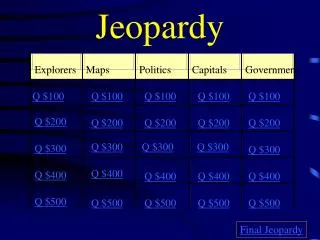
Question A 100 Q: What is the leader of Canada called? Answer
Answer A 100 What is “Prime Minister”? Grid
Question A 200 Q: What type of Economy does Canada have? Answer
Answer A 200 What is “Free Market”? Grid
Question A 300 Q: What mountain range does the U.S. and Canada share? Answer
Answer A 300 What is “Rocky Mountains” ? Grid
Question A 400 Q: What country won the French and Indian war and gained control of Canada? Answer
Answer A 400 Who is “Great Britain”? Grid
Question A 500 Q: The Canadian capital of Ottawa is located on the border of which two provinces? Answer
Answer A 500 What are “Quebec and Ontario”? Grid
Question B 100 Q: Which province borders the Pacific Ocean? Answer
Answer B 100 What is “British Columbia”? Grid
Question B 200 Q: Alberta, Saskatchewan, and Manitoba make up what region of Canada? Answer
Answer B 200 What are “the Prairie Provinces”? Grid
Question B 300 Q: Name the Oceans that Canada borders Answer
Answer B 300 What are “Atlantic, Pacific and Arctic ”? Grid
Question B 400 Q: What is the smallest Canadian province? Answer
Answer B 400 A: What is “Prince Edward Island” Grid
Question B 500 Q: Which province is directly north of the Great Lakes? Answer
Answer B 500 What is “Ontario”? Grid
Question C 100 Q: Who settled on the coast of Canada in 1000 A.D.? Answer
Answer C 100 Who are “the Vikings”? Grid
Question C 200 Q: What connects the Great Lakes with the Atlantic Ocean? Answer
Answer C 200 What is “St. Lawrence Seaway/River”? Grid
Question C 300 Q: Why do most Canadians live along the U.S. border? Answer
Answer C 300 “ The southern border is warmer”? Grid
Question C 400 Q: Which province recently voted for independence from Canada? Answer
Answer C 400 What is “Quebec”? Grid
Question C 500 Q: True or False Canada gained Independence soon after WWII Answer
Answer C 500 A: “False, they became a Dominion after WWII” Grid
Question D 100 Q: Who were the first settlers of Canada? Answer
Answer D 100 Who are “Native Americans”? Grid
Question D 200 Q: What is NAFTA? Answer
Answer D 200 What is “North American Free Trade Agreement”? Grid
Question D 300 Q: Which region of Canada has the largest population? Answer
Answer D 300 What is “Eastern Canada”? Grid
Question D 400 Q: Which province or territory was made especially for the Inuits? Answer
Answer D 400 What is “Nunavut” Grid
Question D 500 Q: Besides language, what is the biggest difference between French and English Canadians? Answer
Answer D 500 What is “their religion”? Grid
Question E 100 Q: What is the number one environmental problem for the Maritime Provinces? Answer
Answer E 100 What is “Over-fishing”? Grid
Question E 200 Q: Which province has had problems with clear-cutting and deforestation? Answer
Answer E 200 What is “British Columbia”? Grid
Question E 300 Q: What is the major industry of Quebec and Ontario? Answer
Answer E 300 What is “Manufacturing”? Grid
Question E 400 Q: Most of the air pollution in Quebec comes from factories located where? Answer
Answer E 400 Where is “The United States”? Grid