Download
1 / 22
220 likes | 350 Views
The project aims to develop a portable, affordable handheld device that accurately measures and displays real-time water quality parameters such as pH, salinity, and temperature. Utilizing Bluetooth technology for wireless transmission, the device addresses the urgent need for water quality monitoring in underdeveloped countries. Current alternatives are prohibitively expensive and geared towards industrial use. This project proposes a design that integrates effective sensors, data logging capabilities, and low-power components, ensuring accessibility and usability for a wider audience.

E N D
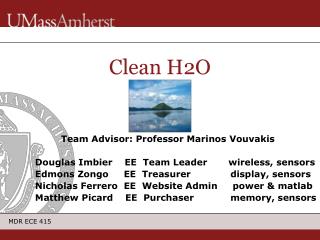
Clean H2O Team Advisor: Professor Marinos Vouvakis Douglas Imbier EE Team Leader wireless, sensors Edmons Zongo EE Treasurer display, sensors Nicholas Ferrero EE Website Admin power, matlab Matthew Picard EE Purchaser memory, sensors
Agenda • Objective • CDR overview • Current design • Future work • Look back
Project Objective Society Need • Need for water quality measuring for under developed countries Engineering Need • Handheld device that will display real-time measurements (pH, salinity, temperature) of a liquid • Wireless transmission using Bluetooth technology
Existing Alternatives • Expensive • Individual sensing devices • Integrated devices but for expert / industrial use • High cost / lead to rentals
Proposed Design Features • Must be more affordable than current designs (≈$300). • Must be portable handheld device. • Must accurately measure pH, salinity, temperature. • Must include real-time display & wireless data transmission (see below) • Must have data log and rudimentary processing capabilities (off-board).
Design Choice (BlueTooth + Computer) GGGGGGGGG MMMMMM Blue Tooth
Why this design choice? • Arduino MINI development board: multiple I/Os, easier software development, reliable. • Nokia 6100 LCD display: real-time measurements, color, cheap, low power. • BlueSmirf Gold Bluetooth: reliable, range ≈100m. • Vernier temperature probe, ph and salinity sensors: accurate, cheap.
CDR progress snapshot • Arduino board wired and programmed. • Used sensors for real time measurements. • Sensors, Display, Arduino integrated. • Showed BlueTooth connection.
Current Design • Finalized design decisions • Display, memory, streaming vs. real time, on/off switches, LED lights, sampling rate, power consumption • LCD integration • Sensor integration • Establish bluetooth connection with PC
Breadboard Design prototype Sensors Sensor Connectors Arduino Display BlueTooth
Sensing Duration vs Sensing Sample Rate • Constrain: No external memory used. • Constrain: Federal regulations require public drinking supplies to be tested every 4 hours. • With given memory size, sample rate will determine how long we can store data. • Utilize Arduino built in memory • 14KB(total) – 8KB(software) = 6KB(left for storage) • 6000bytes/12bytes(data) = 500(samples)
On Power Consumption (Battery Life, cont’d) 9V AAA AA C D Lithium Ion
Power Senario • Arduino and Sensors on all day. • 66.972mAh x 24 hours = 1607.328 mA per day. • Display put on for 1 hour every day. • 70.7mAh x 1 hour = 70.7mA per day. • Bluetooth turned on for 5 minutes every week. • 32.588mAh x 5/(60x7) hour = 0.388 mA per day. • Total current used per day = 1694.322 mA. • Using 9V battery lasted 3.5 hours(tested).
Recap (Accomplishments) • Integrate multiple sensors • Integrate LCD display with Arduino • Integrate Wireless connection (need more work) • Stay below budget (parts break!!)
Future work • Finish Bluetooth • Quantify accuracy • Updated Printed Circuit Board • Case design
Demo Day Deliverables Hardware: • Integrated handheld device • Wireless connectivity Software: • Data logging using Matlab • Arduino programmed using C Suggested Demo: • Show functionality by testing controlled samples
Q & A Thank You!