Download
1 / 29
290 likes | 411 Views
This lesson plan is designed for a special education classroom at Starpoint Intermediate, Lockport, NY, catering to 7 students with varying needs. The objective is to teach students about temperature measurement in Fahrenheit and Celsius. Over 35 minutes, students will engage in interactive learning, thermometers recognition, and independent practice. The lesson aligns with NYS learning standards and includes assessments based on a four-point rubric. Modifications are made to support individual learning needs, ensuring every student can grasp the concept of temperature in a real-world context.

E N D
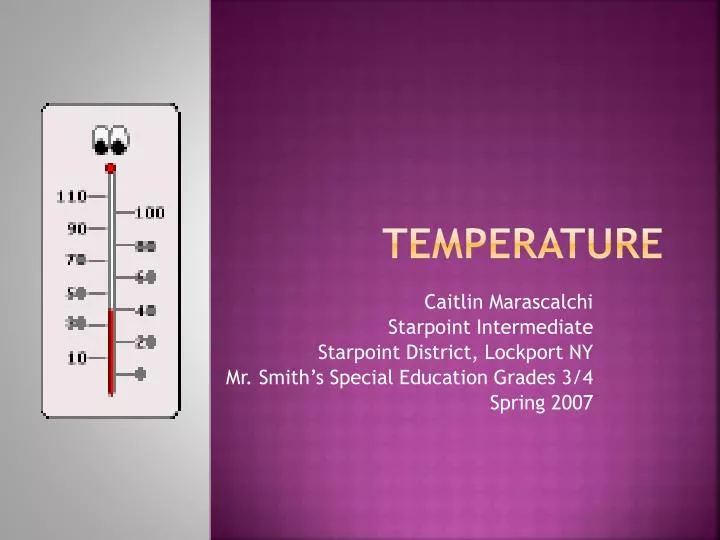
Temperature Caitlin Marascalchi Starpoint Intermediate Starpoint District, Lockport NY Mr. Smith’s Special Education Grades 3/4 Spring 2007
Background Information • This lesson was prepared for a special education classroom made up of 7 students • 3 Third Graders • 4 Fourth Graders • All students have IEP’s- • Some classifications in the room- • Speech/ language • Emotional/ Behavior • Autistic • Mentally Retarted
Purpose • To teach students about temperature and how it is measured so they can apply it in the real world
Time Frame • This lesson will take place during one 35 minute Science period. • 5 minute mini lesson on thermometer recognition • 15 direct instruction with 4th grade group • 15 minute direct instruction with 3rd grade group
Objectives • The students will be able to read a thermometer in Fahrenheit and Celsius with 85% accuracy. • The students will be able to write that a thermometer is the tool that measures temperature with 95% accuracy. • The students will be able to write the temperature for the freezing point with 95% accuracy.
Essential Question • Why is it important to have standard units of measurement?
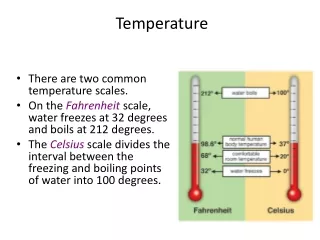
Enduring Understanding • Thermometers are the tool used to measure temperature. • Temperature is how hot or cold something is. • Degrees Fahrenheit and degrees Celsius are the two standard units of measurement for temperature.
Guiding Questions • What tool is used to measure temperature? • What is a temperature that is hot in degrees Fahrenheit and degrees Celsius? • What is a cold and hot temperature in degrees Fahrenheit and degrees Celsius? • What is Fahrenheit and Celsius?
Student Tasks • Measure three different temperatures of water • Answer the temperature questions on the interactive bulletin board • Complete worksheet on temperature independently
NYS Learning Standard: MST • Area: Science • Content Standard: 4- Science • Content Strand: Physical Setting • Key Idea: 3 • Level: Elementary • Grade Level:3 and 4
Performance Indicator 3.1.C Objects have properties that can be observed, described, and/or measured: length, width, volume, size, shape, mass or weight, temperature, texture, flexibility, reflective ness of light.
Assessment Tools • The worksheet S-1 • The students are assessed based on a four point rubric.
STUDENT WORK: DISTINGUISHED
Temperature Rubric RUBRIC Comments: Great Job! I love how each temperature lines up with its unit. I really know that you understand temperature related to weather and your real life. I am so proud of you. 27 out of 28
Student Work: Proficient
Temperature Rubric R U B R I C Comments: Good Job! Be careful when lining the temperature up to the unit. Also- check the boiling point. 23 out of 28
Student Work: Developing
Temperature Rubric Comments: Check spelling- hot day question- and reading a thermometer. 17 out of 28
Envt/Mgt Modifications • Overview of rules provided and displayed • Individual rules and procedures posted and gone over for the independent practice • Student groups are selected by me according to knowledge level and behavior
Instructional Modifications • Students repeat the step-by-step directions/instructions • Choral repetition of important vocabulary and facts
Content/Material Modifications • Graphic organizer given so the students can keep their temperatures in order • Larger thermometers may be given- worksheet may be blown up if necessary • Time- more time at direct instruction for grade four group
Improvements (thanks to my peer review group) • Addition of a pretest • Addition to parent letter about content of temperature unit and home ideas • Rubric update- • Change bonus
Many thanks to EDU 327 class- KeraLe, Jason, Gaye, and Mr. Arnold who helped me revise this to truly make it into a LEARNING EXPERIENCE!