Download
1 / 16
160 likes | 264 Views
A population is a group of organisms of the same species living in a specific area at a given time. This overview explores key concepts including population density, dispersion, and survivorship curves. We differentiate between Type III (r-selected) organisms that thrive in unstable environments, and Type I or II (K-selected) ones found in stable conditions. Additionally, it covers immigration, emigration, and how to calculate growth rates, emphasizing factors that affect population changes in developed versus developing countries.

E N D
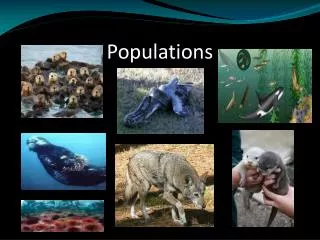
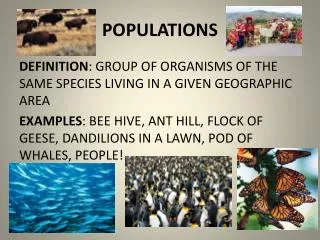
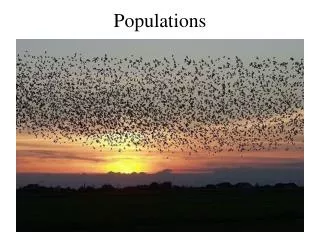
What is a population? • Group of organisms that belong to the same species and live in a particular place at a particular time
Type III Survivorship = R selected • Because they live in an unstable environment with many densitry independent limiting factors they… • Remain small • Use little energy to make each individual • Produce many offspring • Mature early • Die early • Individuals reproduce only once
Type I or II survivorship = K selected • Because they live in a stable environment with many density dependent limiting factors they… • Are large • Use a lot of energy to make each individual • Produce few offspring • Mature slowly • Have long life expectancy • Reproduce more than once
Calculate the growth rate if… • There is a population of 1500 people • 50 people die in one year • 75 people are born in the same year
Growth rate = birth rate – death rate • Birth rate = # of births/total population • Death rate = # of deaths/total population • When will population size increase? Decrease?
Exponential Model In order for this to occur, the population requires _____________ resources.
Logistic Model What is K?
Density Independent Factors What are some examples?
Density Dependent Factors What are some examples?