Understanding the Metric System: Length, Mass, Volume, and Temperature Explained
The metric system is a universal measurement system used by scientists and most countries, based on multiples of ten and deriving from the Greek word "metron," meaning to measure. This system includes standard units for length (meter), volume (liter), mass (kilogram), and temperature (Celsius). It utilizes prefixes such as milli, centi, deci, deka, hecto, and kilo to express values in varying magnitudes. This guide covers key concepts including density, the difference between mass and weight, and fundamental properties of measurement like temperature and heat.

Understanding the Metric System: Length, Mass, Volume, and Temperature Explained
E N D
Presentation Transcript
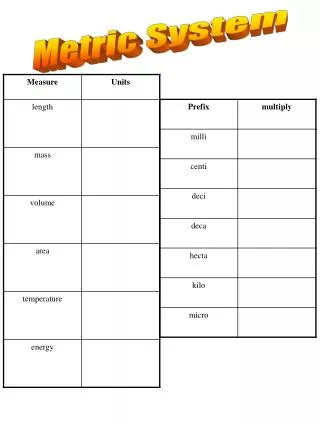
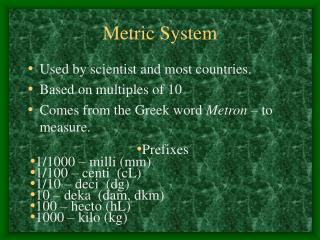
Metric System • Used by scientist and most countries. • Based on multiples of 10 • Comes from the Greek word Metron – to measure. • Prefixes • 1/1000 – milli (mm) • 1/100 – centi (cL) • 1/10 – deci (dg) • 10 – deka (dam, dkm) • 100 – hecto (hL) • 1000 – kilo (kg)
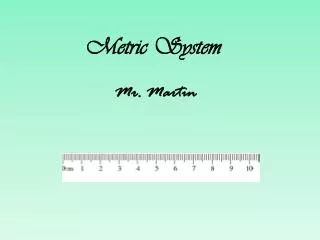
Length • The distance from one point to another. • The base unit is the meter. • Greeks created based on – • 1/10,000,000 of the distance from the north pole to the equator. • How long is your pencil (in metric)?
Volume • The amount of space a substance uses. • The base unit is the liter. • 1 mL = 1/1000 of a liter • 1 cubic centimeter = 1 mL • 1000 cc = 1000 mL = 1 L • Volume displacement – use a graduated cylinder.
Mass • The amount of matter or stuff of an object. • The base unit is the kilogram • Tool used is the triple beam balance scale. • Mass is not the same as weight. Weight is the result of gravity, so it can change. Your mass on the moon stays the same, but your weight is 1/6 of your weight on the earth. • 1 kg = 2.2 pounds on earth • Calculate your mass
Density • The measurement of the amount of mass in a given volume. • Density = mass/volume • Labeled as grams/cubic centimeter or grams/milliliter • Water is 1 gram/mL • Water is the basic comparison, because anything greater will sink in the water.
Temperature vs. Heat • Temperature is the average molecular movement of an object. • Heat is the total molecular movement of an object.
Temperature • The metric system uses Celsius. • Water freezes at 0 degrees • Room temperature is 21 degrees • Body temperature is 37 degrees • Kelvin Scale – 0 K is absolute zero (no molecular movement.