Statistical Ensemble of S- and M-Matrices for Disordered Metals and Quantum Dots
This lecture explores the statistical ensemble framework for S-matrices in chaotic quantum dots, focusing on the differences between unitary S-matrices and pseudo-unitary M-matrices. It discusses crucial concepts such as parameterization using Tn, correlation functions, and the impact of symmetry in reflection and transmission. Furthermore, it highlights the significance of Anderson localization effects and methods to derive variance in conductance, supported by experimental data from ballistic junctions. These insights contribute to a deeper understanding of disordered systems in condensed matter physics.

Statistical Ensemble of S- and M-Matrices for Disordered Metals and Quantum Dots
E N D
Presentation Transcript
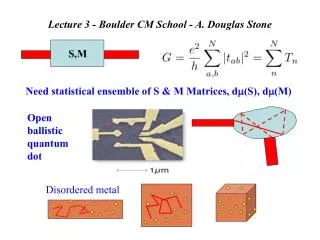
S,M Disordered metal Lecture 3 - Boulder CM School - A. Douglas Stone Need statistical ensemble of S & M Matrices, d(S), d(M) Open ballistic quantum dot
Dyson Simplest possibility: completely uniform on the matrix space • This is possible for unitary S-matrix (circular ensembles), • Not for pseudo-unitary M-matrix (non-compact space) Hypothesis: P(S) = d(S)/V for chaotic quantum dot dS2 = Tr{dSdS†} = ∑ij gij dqiqj => d(S) = (det[g])1/2∏idqi We need a parameterization in term of {Tn}
MesoNoise WL UCF Coulomb Gas analogy Circular ensemble: take V = 0, P({Tn}) only from invariant measure;what to do with jpd? For Var(g) need Need 1-pt and 2-pt correlation fcns of the jpd of {Tn}
Use recursion relations, asymptotic form of pn : (normalized to N - so that G = (e2/h) T Many methods to find these fcns and the two-pt corr. fcn is “universal” upon rescaling if only logarithmic correlations Nice approach for =2 is method of orthogonal polynomials pn= orthog poly, choose Legendre, [0,1] Same method gives K(T,T’) in terms of pN pN-1
(T)/N 0 1 T What do we expect for this system? Classical symmetry betweeen reflection and transmission => <R> = <T> = N/2 Need to go to next order in N-1 to get WL effect
Tr{r r†} = R SCOE =UUT U Coherent backscattering Off-diagonal correlations Coherent backscattering < R >COE GWL = -(2e2/h)(1/4) The Mystery Can get order 1/N effects easily for the circular ensemble - do averages over unitary group U(2N) Similarly Var(g) = (1/8)
CB only Actual data from ballistic junction -M. Keller and D. Prober 1995 Agrees well with experiment and simulations
RMT =2 Variance of g for a quantum dot (Chan et al., 95),Note factor of two reduction when B ≠ 0 (=2)
M2 M1 M = M1M2 dM(dL) M(L) DMPK Equation Disordered Wires No T R symmetry <g> = N(l/L), l = mfp<R> ≈ N, l << L L Use M, not S Parameterize M(L) with polar decomposition PL+dL= PL(M) PdL(dM)(ML+dL - ML• dMdL) “isotropic”
{n} = Inverse localization lengths 1D case solved early(1959), Mello (88,91), Beenakker (93),RMP (97) Qualitative picture: Imry (86), open and closed channels
1/2L UCF: Var(g) = 2/(15) , gWL = -1/3 1 2 N Nopen Nclosed g ≈ Nopen = Nl/L => 1 = 1/(2Nl) • When L > 2Nl => g = exp[-L/(Nl)] => quasi-1d localization, = Nl. • Fixed N (width) and increasing L always leads to localization. Var(g) = Var(Nopen) ≈ 1 (spectral rigidity, P({n}) ∏open | n - m| )
closed Tunnel barrier closed open Chaotic junction closed disordered open Disordered wire Ballistic/chaotic Eigenvalue density
s y y’ x x’ b a sinb = ±bπ/kW Semiclassical Method for Ballistic Junctions Obtained by stationary phase integration of FT of Gscl(r,r’,t);0∫ T Ldt Ss (E) = r∫ r’pdq = (h/2π)kLs (for billiard) Now do ∫∫ dydy’ for tab by stationary phase:
g = N/2 comes from terms s=u, WL correction from s≠ u, but not simply from time-reversed pairs of path Conductance fluctuations come from random interference of paths, sensitive to B, k - Var(g) ≈ 1 comes from interference of all paths, require correlated actions for different paths Fundamentally different from familiar speckle patterns
Look at diagonal terms, s=u; Can get dynamical scales just from diagonal terms Sum starts to decay when kLs ≈ π => kc = < π/L> = cFor diffusive case Ls = vf tD => kc = Eth/hvf Similar analysis give Bc = (h/e)/<Aencl> Quantitative approach next time.