Download
1 / 6
60 likes | 199 Views
This document outlines the history and testing results of Nb3Sn coated cavities in the ERL1-4 project. It reports on the effectiveness of high-pressure rinsing (HPR), demonstrating a flat Q vs. E performance up to quench at ~13 MV/m, with Q values around 1e10. The study includes comprehensive tests revealing no degradation at 120 K and confirms good performance up to 20 MV/m post-BCP coating removal and reapplication. The measurements of DC flux penetration at 6.3 K highlight the detailed relationship between flux behavior and magnetic fields, contributing to improved cavity performance.

E N D
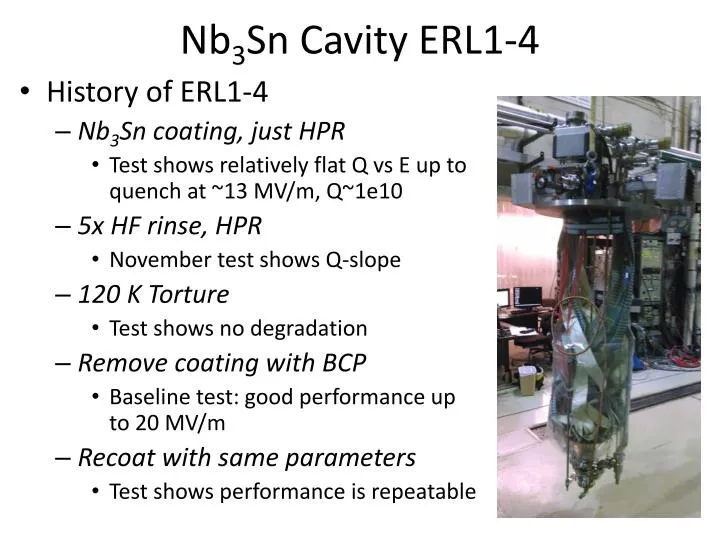
Nb3Sn Cavity ERL1-4 • History of ERL1-4 • Nb3Sn coating, just HPR • Test shows relatively flat Q vs E up to quench at ~13 MV/m, Q~1e10 • 5x HF rinse, HPR • November test shows Q-slope • 120 K Torture • Test shows no degradation • Remove coating with BCP • Baseline test: good performance up to 20 MV/m • Recoat with same parameters • Test shows performance is repeatable
Measuring DC Flux Penetration Field • Nick made a 1760-winding NbTi solenoid • Get cavity to a few MV/m, then apply DC field, watch Pt (or Pr) • When RF field drops, flux from DC field has penetrated to RF surface • Hall probe measures magnetic field
T = 6.3 K Flux penetration
Flux penetration as a function of T2 Lines with x-intercept matching Tc of Nb or Nb3Sn and y-intercepts fitted by eye Approximate Bsh of Nb with correction for field at hall probe
From Nick’s thesis: Ratio of X’s gives magnetic field correction for hall probe