Institutionalizing Quality Instruction: Responsive Educational Practices at University of Oregon
This document outlines the strategies for institutionalizing and sustaining quality instructional practices within the College of Education at the University of Oregon. It emphasizes the importance of Responsive Instructional Practices (RTI) and highlights the active ingredients that drive effective education, such as data-based decision-making, collaboration, differentiated instruction, and shared instructional leadership. The goal is to foster collegiality and continuous learning among educators, creating a collaborative environment essential for effective teaching and enhanced student learning.

Institutionalizing Quality Instruction: Responsive Educational Practices at University of Oregon
E N D
Presentation Transcript
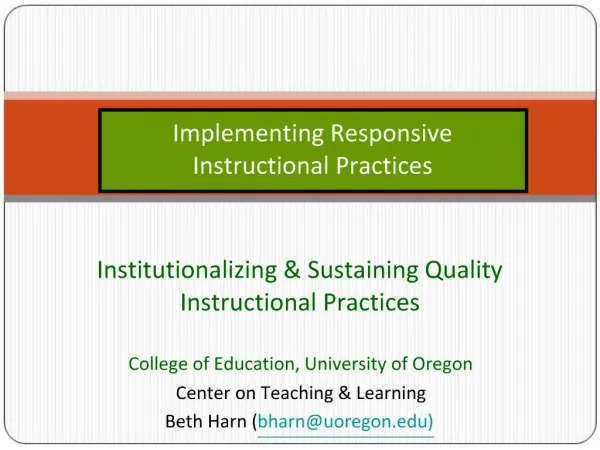
1. Institutionalizing & Sustaining Quality Instructional Practices
College of Education, University of Oregon
Center on Teaching & Learning
Beth Harn (bharn@uoregon.edu) Implementing Responsive Instructional Practices
2. Objectives The “Active Ingredients” of RTI
Data-based decision making
Collaboration and coordination of instruction
Differentiated Instruction
Sustaining & Institutionalizing Responsive Instructional Practices
Implementing Shared Instructional Leadership
Promoting collegiality and continual learning within each building
3. RTI: A Change to the System RTI, by design, is a shared responsibility of general and special education to implement prevention and intervention-focused practices, which will require unprecedented collaboration and coordination
Our challenge is supporting this change process across and in collaboration with all educators
“People are changed, not by coercion or intimidation, but by example”. (Manske, 1999)
“If student learning is the most important function of schools, then instruction is where we focus our time and attention.” (Fielding, Kerr & Rosier, 2007)