Download
1 / 9
90 likes | 207 Views
Enhance your C/C++ programming skills for ACM competitions with insights into problem-solving strategies. Understand how to handle anxieties and effectively interpret judges' expectations. Learn dynamic programming techniques to create tables of partial results, allowing for systematic problem resolution. With examples, including the "divis" problem and the Knapsack Problem, gain practical knowledge to improve your algorithmic thinking. This guide will help you navigate the complexities of competitive programming with confidence.

E N D
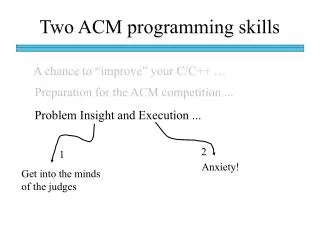
Two ACM programming skills A chance to “improve” your C/C++ … Preparation for the ACM competition ... Problem Insight and Execution ... 2 1 Anxiety! Get into the minds of the judges
Get into the minds of the judges Key Skill #1: mindreading 100% 0% “What cases should I handle?” spectrum
Key Skill #2: anxiety Anxiety!
Dynamic Programming Strategy: create a table of partial results & build on it. divis.cc T(n) = number of steps yet to go T(n) = T(3n+1) + 1 if n odd T(n) = T(n/2) + 1 if n even
Dynamic Programming Keys: create a table of partial results, articulate what each table cell means, then build it up... divis.cc j = items considered so far Table T 0 1 2 3 4 5 6 1 1 6 2 -3 0 the list 1 4 i = possible remainder the divisor 2 3 T[i][j] is 1 if i is a possible remainder using the first j items in the list.
Dynamic programs can be short #include <cstdio> #include <iostream> #include <vector> vector<int> v(10000); vector<bool> m(100); // old mods vector<bool> m2(100); // new mods int n, k; bool divisible() { fill(m.begin(),m.end(),false); m[0] = true; for (int i=0; i<n; i++) { /* not giving away all of the code */ /* here the table is built (6 lines) */ } return m[0]; } int main() { cin >> n; // garbage while (cin >> n) { cin >> k; for (int i=0; i<n; i++) { cin >> v[i]; v[i] = abs(v[i]); v[i] %= k; } cout << (divisible() ? "D" : "Not d") << "ivisible\n"; } cout << endl; } acknowledgment: Matt Brubeck STL: http://www.sgi.com/Technology/STL
General ACM Programming Try brute force first (or at least consider it) -- sometimes it will work fine… -- sometimes it will take a _bit_ too long -- sometimes it will take _way_ too long Best bugs from last week: getting the input in the “pea” problem: filling in the table in the “divis” problem: for (int j=1 ; j<N ; ++j) { cin >> Array[i]; } Table[i + n % k] = 1; Table[i - n % k] = 1;
New Problem Word Chains hertz jazz hajj zeroth doze aplomb ceded dozen envy ballistic yearn Input A list of words Output yes or no -- can these words be chained together such that the last letter of one is the first letter of the next… ?
Knapsack Problem objectwt.val. 1 3 8 2 2 5 3 1 1 4 2 5 Maximize loot w/ weight limit of 4. w Weight available for use Number of objects considered 0 1 2 3 4 1 V(n,w) = max value stealable w/ ‘n’ objects & ‘w’ weight 2 3 4 n V(n,w) =