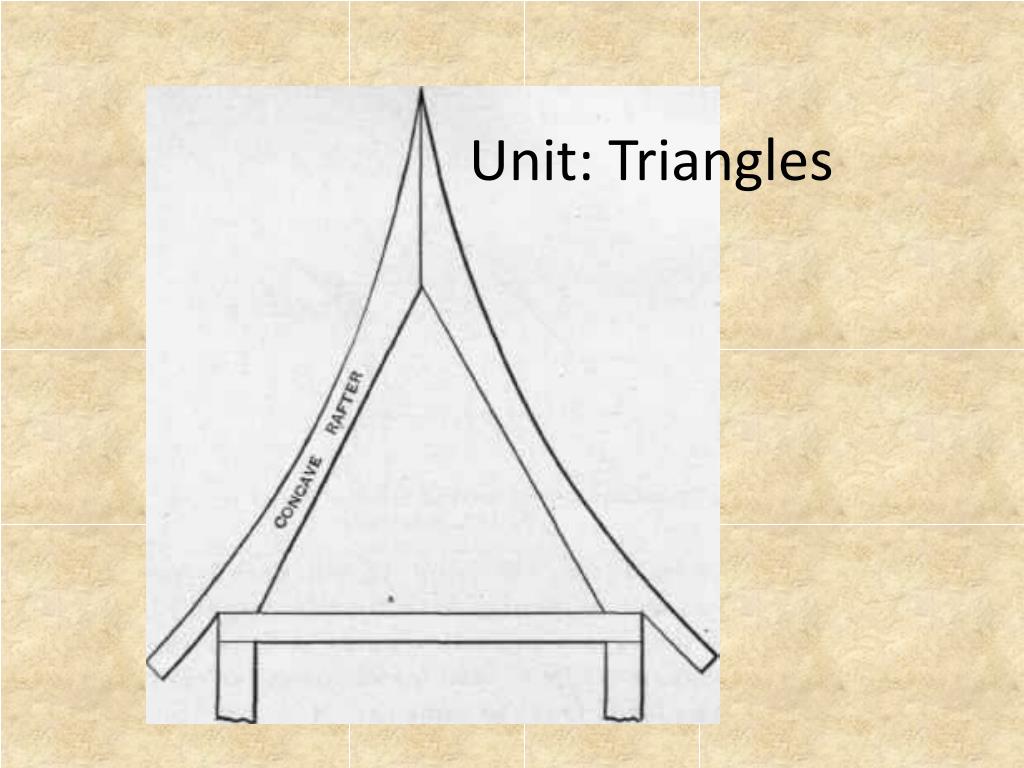
Unit: Triangles. 3-4 Parallel lines and Triangle Sum Theorem. Objective: To classify triangle and find the measure of their angles To use exterior angle Theorem. Classifying Triangle. Classify by angles: Classify by sides:. Theorems. Triangle-Angle Sum Theorem:
An Image/Link below is provided (as is) to download presentation
Download Policy: Content on the Website is provided to you AS IS for your information and personal use and may not be sold / licensed / shared on other websites without getting consent from its author.Content is provided to you AS IS for your information and personal use only.Download presentation by click this link.While downloading, if for some reason you are not able to download a presentation, the publisher may have deleted the file from their server.During download, if you can't get a presentation, the file might be deleted by the publisher.
Theorems Triangle-Angle Sum Theorem: Sum of the angles is 180. Exterior Angle Theorem: sum of the remote interior angles equals the exterior angle C + B = BAD 1 2 Remote interior angles Exterior angle
TRY Find the measure of each angle. 62-25 = 37 180-(56+62) =62 180 – 62 = 118 OR 56 + 62 = 118
Example 3 Classify the triangles. • By its sides 18cm, 20 cm, 18cm isosceles b) By its angles 91,20 ,69 obtuse
Try Classify the triangle. The measure of each angle is 60. Equilateral and equiangular
Closure • What is the sum of the interior angles of a triangle? 180 2) What is the relationship of the exterior-angle and the two remote interior angles? Sum of the remote interior angles = exterior angle.
3-5 Polygon Angle Sum Objective: To classify polygons To find the sums of the measures of the interior and exterior angles of a polygon
Vocabulary • Polygon • closed figure with the at least three segments. • Concave Convex • Equilateral polygon • All sides congruent • Equiangular polygon • All angles congruent • Regular polygon • Equilateral and equiangular polygon convex convex concave concave convex
Polygons Polygon Angle Sum Theorem 180(n-2) Polygon Exterior Angle Theorem: Sum of all exterior angles is 360 degrees.
Example 1 Pentagon • Name the polygon by its sides • Concave or convex. • Name the polygon by its vertices. • Find the measure of the missing angle Convex QRSTU (5-2)180 = 540 130+54+97+130 = 411 540 – 411 = 129
Example 2 Find the measure of an interior and an exterior angle of the regular polygon.. (7-2)180/7 = 128 4/7 360/7 = 51 3/7
Determine the number of Sides • If the sum of the interior angles of a regular polygon is 1440 degrees. 1440 = 180(n-2) 8 = n-2 10 = n it is a decagon • Find the measure of an exterior angle 360/10 = 36 degrees
Closure • What is the formula to find the sum of the interior angles of a polygon? (n-2)180 • What is the name of the polygon with 6 sides? hexagon • How do you find the measure of an exterior angle? Divide the 360 by the number of sides.
VOCBULARY • RATIO- COMPARISON OF TWO QUANTITIES. • PROPORTION- TWO RATIOS ARE EQUAL. • EXTENDED PROPORTION – THREE OR MORE EQUILVANT RATIOS.
PROPERTIES OF RATIOS a c is equivalent to: 1) ad = bc b d 2) b d 3) a b a c c d 4) a + b c + d b c
Example 1 • 5 20 x 3 b) 18 6 n + 6 n • 15 = 20x • ¾ = x • 18n = 6n +36 • 12n = 36 • n = 3
Example 2 • 1 7/8 16 x • X = 16 (7/8) • X = 14 ft The picture above has scale 1in = 16ft to the actual water fall If the width of the picture is 7/8 inches, what is the size of the actual width of the part of the waterfall shown.
Vocabulary • Similiar polygons- (1) corresponding angles are congruent and (2) corresponding sides are proportional. ( ~) • Similarity ratio – ratio of lengths of corresponding sides
Example 1 • Find the value of x, y, and the measure of angle P. • <P = 86 • 4/6 = 7/Y X/9 = 4/6 • 4Y = 42 6X = 36 • Y = 10.5 X = 6
Example 2 Find PT and PR 4 = X 11 X+12 11X = 4X + 48 7X = 48 X = 6 PT = 6 PR = 18
Example 3 Hakan is standing next to a building whose shadow is 15 feet long. If Hakan is 6 feet tall and is casting a shadow 2.5 feet long, how high is the building? X = 15 6 2.5 2.5X = 80 X =
TRY • A vertical flagpole casts a shadow 12 feet long at the same time that a nearby vertical post 8 feet casts a shadow 3 feet long. Find the height of the flagpole. Explain your answer.
Key Concept Perpendicular bisectors – forms right angles at the base(side) and bisects the base(side). Angle Bisectors– bisects the angle and equidistant to the side.
Try 1 WY is the bisector of XZ 4 7.5 9 Isosceles triangle
Try 2 6y = 8y -7 7 = 2y y = 7/2 21 21 Right Triangle
5-3 Concurrent Lines, Medians, and Altitudes Objective: • To identify properties of perpendicular bisectors and angle bisectors • To Identify properties of medians and altitudes