Understanding Parallelograms: Properties, Examples, and Applications
A parallelogram is a quadrilateral with two pairs of parallel sides. Key properties include congruent opposite sides, congruent opposite angles, and supplementary consecutive angles. Diagonals of a parallelogram bisect each other. This guide provides examples that utilize these properties, including finding measures and proving congruencies. Illustrative problems cover coordinate plane applications and two-column proofs. Perfect for students learning geometry concepts, offering a thorough understanding of parallelograms and their characteristics.

Understanding Parallelograms: Properties, Examples, and Applications
E N D
Presentation Transcript
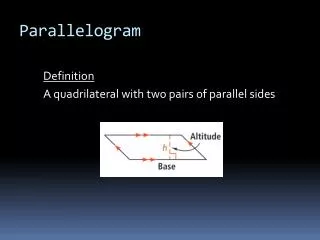
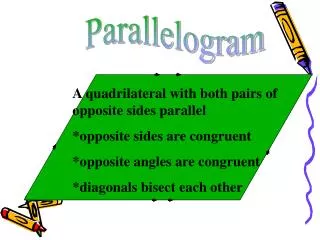
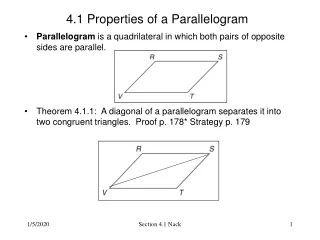
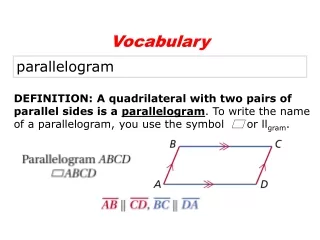
Vocabulary parallelogram DEFINITION:A quadrilateral with two pairs of parallel sides is a parallelogram. To write the name of a parallelogram, you use the symbol or llgram.
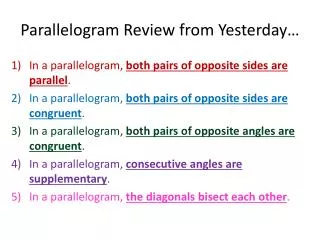
PROPERTIES OF PARALLELOGRAMS IF PARALLELOGRAM THEN… 1. Two pairs opposite sides parallel 2. Two pairs opposite sides congruent 3. Two pairs opposite angles congruent 4. Consecutive angles supplementary 5. Diagonals bisect each other
Example 1: Using Properties of Parallelograms to Find Measures WXYZ is a parallelogram. Find YZ and mZ.
diags. bisect each other. Check It Out! Example 2 EFGH is a parallelogram. Find JG. EJ = JG Def. of segs. 3w = w + 8 Substitute. 2w = 8 Simplify. w = 4 Divide both sides by 2. JG = w + 8 = 4 + 8 = 12
Check It Out! Example 3AB EFGH is a parallelogram. Find FH.
L K J Example 4: Parallelograms in the Coordinate Plane Three vertices of JKLM are J(3, –8), K(–2, 2), and L(2, 6). Find the coordinates of vertex M. Since JKLM is a parallelogram, both pairs of opposite sides must be parallel -- same slopes or same Rise and Run.
Example 5ab: Using Properties of Parallelograms in a Proof Write a two-column proof. Given: ABCD is a parallelogram. Prove:∆AEB∆CED Write a two-column proof. Given: GHJN and JKLM are parallelograms. Prove:H M
Lesson Quiz: Part I In PNWL, NW = 12, PM = 9, and mWLP = 144°. Find each measure. 1.PW2. mPNW
Lesson Quiz: Part II QRST is a parallelogram. Find each measure. 3.TQ4. mT
Lesson Quiz: Part III 5. Three vertices of ABCD are A (2, –6), B (–1, 2), and C(5, 3). Find the coordinates of vertex D.
Lesson Quiz: Part IV 6. Write a two-column proof. Given:RSTU is a parallelogram. Prove: ∆RSU∆TUS