Download
1 / 9
90 likes | 208 Views
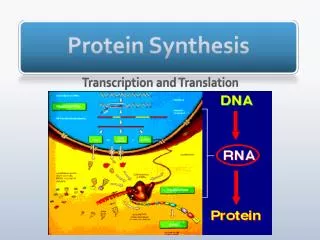
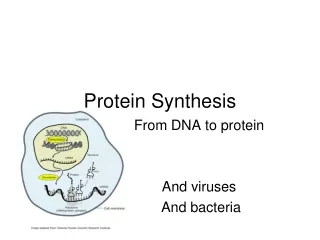
Protein synthesis is a fundamental biological process involving the conversion of genetic information from DNA to proteins. It begins with transcription, where RNA polymerase synthesizes mRNA from the DNA template. Unlike DNA, RNA is single-stranded, contains uracil instead of thymine, and has ribose as its sugar. The mRNA molecule is then translated into a polypeptide chain of amino acids at the ribosome, utilizing tRNA to match codons with corresponding amino acids. This essential process exemplifies how genetic code translates into functional proteins.

E N D
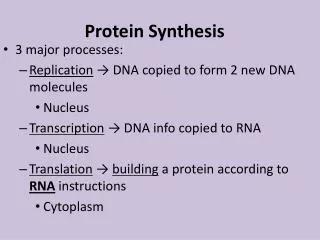
RNA Single-stranded Has uracil as a base Ribose as the sugar Carries protein-encoding information DNA Double-stranded Has thymine as a base Deoxyribose as the sugar Carries RNA-encoding information Two types of nucleic acids
Transcription RNA polymerase reads the nucleotides on the template strand and creates an RNA molecule that looks like the coding strand. DNA DNA coding strand 5’ G T C A T T C G G 3’ 3’ C A G T A A G C C 5’ • DNA template strand
3’ G U C A U U C G G 5’ RNA Transcription The new RNA molecule is formed by incorporating nucleotides that are complementary to the template strand. DNA DNA coding strand 5’ G T C A T T C G G 3’ 3’ C A G T A A G C C 5’ • DNA template strand
Types of RNA Abbrev.Function mRNA Messenger RNA - encodes protein rRNA Ribosomal RNA - part of ribosome - used to translate mRNA into protein tRNA Transfer RNA - couples the region which binds the mRNA codon and its amino acid
DNA template strand DNA C A G C A G T T T Transcription A A G U C A G U C Messenger RNA mRNA Codon Codon Codon Translation Polypeptide (amino acid sequence) Protein Lysine Serine Valine Translation • The process of reading the RNA sequence of an mRNA and creating the amino acid sequence of a protein is called translation.
http://www.lewport.wnyric.org/jwanamaker/animations/Protein%20Synthesis%20-%20long.htmlhttp://www.lewport.wnyric.org/jwanamaker/animations/Protein%20Synthesis%20-%20long.html