Download
1 / 6
70 likes | 215 Views
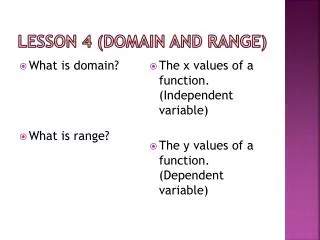
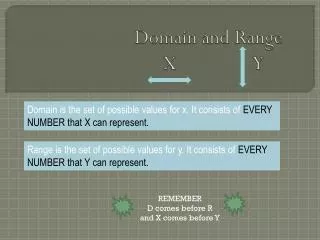
Domain and range are fundamental concepts in mathematics. The domain refers to all possible values for x, while the range refers to all possible values for y. Closed circles indicate that a number is included in the domain and range, while open circles indicate it is not. For instance, the domain of a function can be represented as [-6, 7), indicating that it includes -6 but is open at 7. Similarly, the range could be [-3, 2), including -3 but not 2. Understanding these concepts helps in graphing and analyzing functions accurately.

E N D
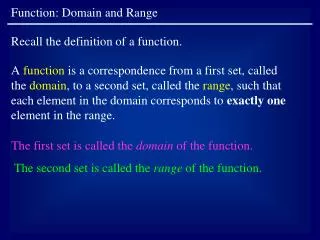
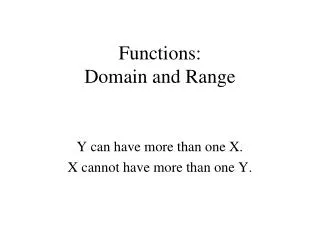
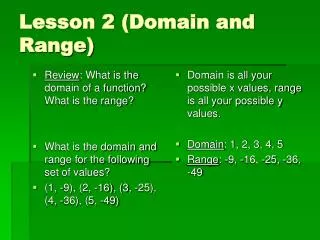
Domain and Range X Y Domain is the set of possible values for x. It consists of EVERY NUMBER that X can represent. Range is the set of possible values for y. It consists of EVERY NUMBER that Y can represent. REMEMBER D comes before R and X comes before Y
This closed circle tells me that my domain exists at -6 and my range exists at -3. Symbols When a line segment has a closed circle, that number is included in your domain and range. When a line segment has an open circle, that number is not included in your domain and range. This open circle tells me that my domain gets infinitely close to 7 but does not exist at 7 and my range gets infinitely close to 2 but does not exist at 2.
NOTATION Closed circles are represented by brackets [ ] or by the inequalities ≤ and ≥. Open circles are represented by parenthesis ( ) or by the inequalities < and >. DOMAIN [-6,7) or -6 ≤ x < 7 RANGE [-3,2) or -3 ≤ x < 2
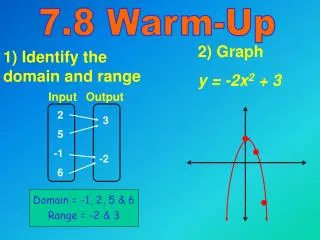
Domain: Every number that x can represent. x = -7, 2, 6, 7 -6 ≤ x ‹ 7 [-6,7)
Range: Every number that y can represent. -4 ≤ y ‹ ∞ [-4, ∞) y = -4, 0,3
1 2 • 3 4 • •