Download
1 / 2
20 likes | 128 Views
Learn about calculating medians, simple versus complex models, correlation coefficients, skewness and kurtosis, descriptive statistics for regression analysis, and statistical tests like Jarque-Bera Test.

E N D
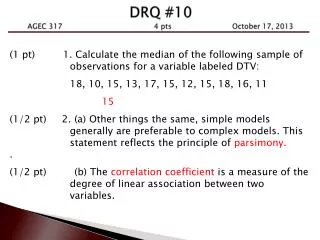
DRQ #10AGEC 317 4 pts October 17, 2013 (1 pt) 1. Calculate the median of the following sample of observations for a variable labeled DTV: 18, 10, 15, 13, 17, 15, 12, 15, 18, 16, 11 15 (1/2 pt) 2. (a) Other things the same, simple models generally are preferable to complex models. This statement reflects the principle of parsimony. . (1/2 pt) (b) The correlation coefficient is a measure of the degree of linear association between two variables.
3. Concerning descriptive statistics of variable indigenous to regression analysis: (1/2 pt) (a) The skewness coefficient for the variable PSE is .45. The distribution of PSE has a tail on the right. (1/2 pt) (b) The kurtosis coefficient for any normal distribution is 3. (1/2 pt) (c) If the mean for a particular variable is equal to 16, and if the standard deviation is equal to 4, then the coefficient of variation is equal to 25% . (1/2 pt) (d) Name the statistic to conduct tests normally. Jarque – Bera Test