Download
1 / 34
340 likes | 468 Views
Before computers, Op Art emerged as a mesmerizing form of artistic expression, characterized by geometric shapes and vibrant colors to create stunning optical illusions, often suggesting movement. Delve into the concepts of optical and non-objective art, guided by pioneers like Victor Vasarely and Bridget Louise Riley. Engage in hands-on activities using simple tools such as rulers, compasses, and colored pencils to explore techniques for creating your own captivating illusions. Unleash your creativity and understand the science of perception through art.

E N D
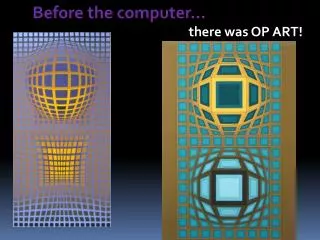
Before the computer… there was OP ART!
OP Art = a form of art characterized by the use of geometric shapes and brilliant colors to create optical illusions (such as motion).
Vocabulary: Optical Illusion = visual images that differ from objective reality Even though your mind wants to believe that some of the squares are closer and some farther away; the real difference is due to the variation of size.
Non-objective Art = art that does not represent an object, person or place. Abstract Art is (more accurately) the simplification of a subject; whereas, non-objective art is created without a subject in mind.
VictorVasarely is considered the father of OP Art. He was born 1908 in Hungary. He later settled in Paris in 1930’s and became a French citizen 1959 . Victor created hypnotic works that look as if they were created on a computer beginning in The 1940s.
Vasarely’s contemporary works featured animated surfaces of geometric forms and interacting colors. In the 1960s he used even brighter colors to suggest movement through optical illusion.
Bridget Louise Riley was born 24 April 1931 in London; she is a famous OP Artist who created many black and white images in the 1960’s that created a sense of motion.
Today, you will try your hand at a few techniques designed to help you better understand the way artists create optical illusions! Supplies: Ruler, compass, protractor, sharpened 2B pencils, Erasers, color pencils and practice sheets to follow along with teacher’s instructions