The Progressive Era: Social Justice and Reform Movements (1890-1920)
190 likes | 320 Views
The Progressive Era (1890-1920) was a pivotal time in American history marked by a middle-class movement aimed at addressing the challenges of industrialization, urbanization, and immigration. Driven mainly by urban, native-born, white professionals, the movement sought social justice through reforms in government, labor rights, and education. Muckrakers exposed corruption and the plight of the working class, leading to significant reforms such as direct elections and workplace safety laws. Notable figures included Eugene V. Debs and Jane Addams, who advocated for social change and the betterment of society.


The Progressive Era: Social Justice and Reform Movements (1890-1920)
E N D
Presentation Transcript
Progressive Era 1890/95-1920 1900-1917
Introduction • A middle-class movement-mostly urban, white, native-born and white-collar professionals • Some upper class-business leaders who were committed to social justice • Response to challenges of industrialization, urbanization and immigration
Beliefs/Issues • New ideas and honest, efficient govt. can bring about social justice; get rid of corrupt govt. officials/organizations and make govt. responsive to the people’s needs • Industrialization and urbanization have created troubling problems-wretched living conditions, harsh conditions for laborers • Eliminate the abuses of big business; create opportunities for small businesses • Reduce the gap between rich and poor (enter Socialist party)
Socialism • Socialists wanted a complete change of the system, not merely reform, but, socialism and progressivism did overlap on some issues • Socialist Eugene V. Debs won 400,000 votes in 1904 and nearly a million in 1912 as presidential candidate • U. Sinclair was a Socialist
Muckrakers/Literature • Sensational investigative reporters/stories • Published in magazines like McClure’s books (1893) • S.S. McClure-magazine that exposed Tammany Hall/Boss Tweed (controlled NYC politics and helped immigrants) (Thomas Nast-”The Vulture” • Jacob Riis, “How the other half lives”-about NYC tenements • Lincoln Steffens-”The Shame of the Cities”-1904; exposed corruption of boss politics • Ida Tarbell-”History of the Standard Oil Company”-1904; ruthless practices of monopoly • Upton Sinclair-”The Jungle”-1906-industry conditions in Chicago’s meatpacking industry • Naturalist novels portraying human misery and struggles of the common people also became popular
Municipal Level Reform • Reforms begin in the cities, work to eliminate the corruption of machine politics • In the 1890s, many bosses were replaced with city managers or other forms of expert govt. • Worked to regulate urban utilities; some even advocated public ownership • 1900-a massive hurricane hit Galveston, TX.; left it in ruins-killed more than 8000; as an emergency measure, Galveston replaced its mayor with a 5-person commission (5 people=legislative body) • Commission form of govt.-proved efficient through rebuilding effort; many adopt it
Electoral Reform • Robert M. Lafollette: direct primary-citizens themselves vote to select nominees for upcoming elections • 17th amendment (1913)-direct election of senators • Initiative-gave people the power to put a proposed new law on the ballot; voters could pass laws • Referendum-allow citizens to approve or reject laws passed by a legislature • Recall-voters the power to remove public servants from office before their terms end • By and large, these reforms failed to oust party bosses and special interest who learned to control the new mechanisms
Labor Reform • Early 1900s-U.S. had the highest rate of industrial accidents (long hours, poor ventilation, fumes, unsafe machinery, etc.) • Early year some 30,000 workers died on the job; another half a million were injured • Triangle Shirtwaist Factory fire (March 1911)-NYC, kills 146, many young women, little chance of escaping as managers had locked most of the exits; many jump in desparation • Leads to workplace safety laws and workers compensation laws • Many attempts to limit workday (to 10 hours), especially with women • Child labor reform-min. age for employment (12-16) and max. hours (10); Keating-Owens Act-bans child labor, but 2 years later will be ruled unconstituional • Not until 1938 that child labor will be banned for good
Social Reform-Assistance • Social Gospel-follow the Bible’s teachings-about charity and justice, people could make society “the kingdom of God” • Est. of settlement houses-community centers that provided social services to the urban poor (gave working mothers classes in day care, taught English to immigrants, etc.) • Jane Addams-Hull House-in Chicago, grew to 13 buildings and inspired other college-educated, middle-class women to become social workers
Social Reform-Education • A number of states passed laws requiring a child attend school until a certain age • John Dewey-criticized schools for teaching memorization, encouraged creative thought and also wanted schools to teach practical subjects/skills
Social Reform-Morals • Several states set up censorship boards to control movies • Prostitution-Red-light districts like New Orleans “Storyville” were shut down • 1910-legislation passed to make it illegal to transport a woman across state lines for “immoral purposes” • Theda Bara (1885-1955)-the original vamp (sex symbol); sensuality in movies deeply troubled moral reformers
Social Reform-Prohibition • The temperance movement was one of the oldest and strongest reform movements • By 1900, 25% of Americans lived in “dry” counties or states, but, total per capita alcohol consumption was on the rise • Protestant rural native born reformers vs. Catholic urban immigrants • 18th amendment (1919)-prohibition-outlawed manufacture, sale and transport of alcoholic beverages
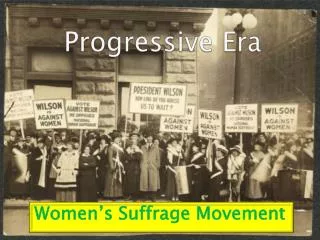
Social Reform-Women • Education helped women achieve their goals • Worked in prohibition movement • Some women worked against sweatshops, fought for min. wage, 8-hr. workdays and children’s rights • Boldest goal=suffrage; wanted to make sure govt. protected their children, fostered education and supported family life • Suffrage leaders: Susan B. Anthony, Elizabeth Cady Stanton • 19th amendment (1920)-cannot deny right to vote based on gender
Struggle vs. Discrimination • Booker T. vs. W.E.B. DuBois • Niagara Movement-group met at Niagara Falls, expressed DuBois’ ideas, never grew large enough, needed a more powerful voice • NAACP-formed in response to a riot; to protect lives, secure the right to vote and civil rights • Anti-Defamation League-goal to defend Jews and others vs. physical and verbal attacks, vs. false statements, and to secure justice and fair treatment for all
Immigration Issue • Some believed only fewer and “better” immigrants could reduce the social problems of the city • Immigration restriction league-1894-founded to oppose the “new” immigrants • Some restriction already (Chinese Exclusion Act), but much more will follow WWI
The Presidents • Theodore Roosevelt-1901-1909 • William Howard Taft-1909-1913 • Woodrow Wilson-1913-1921