Central Nervous System
160 likes | 268 Views
This comprehensive overview focuses on the Central Nervous System (CNS), detailing the role of glial cells, such as astrocytes and oligodendrocytes, and the composition of cerebrospinal fluid (CSF). It describes the brain structure, including the brainstem, cerebellum, diencephalon, and the importance of various nuclei and centers within these regions. Key functions, including the maintenance of homeostasis, regulation of vital centers, and coordination of muscle movements, are also highlighted. An essential guide for understanding the complexities of CNS.


Central Nervous System
E N D
Presentation Transcript
Central Nervous System Part 1 Glial Cells and CSF Brainstem, Cerebellum and Diencephalon
Glial Cell Types: Most of the brain is made up of cells that support the nervous tissue CNS PNS Neuron VENTRICLE Astrocyte Ependy- mal cell Oligodendrocyte Fig. 49-6a Schwann cells Microglial cell Capillary (a) Glia in vertebrates Oligodendrocytes: produces myelin sheath Astrocytes: maintains environment for nerve impulses, blood brain barrier, provides nutrients, picks up excess NT Microglial Cell: WBC of the brain Ependymal Cells: lines ventricles and makes CSF
Protection: Skull, Meninges and CSF: ~ 150 mL CSF in ventricles and subarachnoid space • Dura mater, arachnoid , pia mater • CSF Circulation: lateral > interventricular foramen > 3rd > cerebral aqueduct > 4th • Superior sagital sinus and arachnoid villi • Capillaries are different: tight junctions combine ET cells
choroid plexsus: specialized capillary network projecting from the pia mater into the ventricles of the brain forming cerebral spinal fluid (70% of CSF) 99% water, (glucose, aa, salt, less density and protein than plasma)
Telencephalon Forebrain Diencephalon Mesencephalon Midbrain Metencephalon Fig. 49-9ab Hindbrain Myelencephalon Mesencephalon Metencephalon Midbrain Myelencephalon Hindbrain Diencephalon Spinal cord Forebrain Telencephalon (a) Embryo at 1 month (b) Embryo at 5 weeks
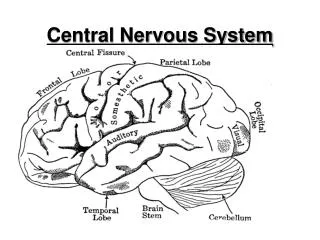
Cerebrum (includes cerebral cortex, white matter, basal nuclei) Diencephalon (thalamus, hypothalamus, epithalamus) Midbrain (part of brainstem) Pons (part of brainstem), cerebellum Fig. 49-9c Medulla oblongata (part of brainstem) Diencephalon: Cerebrum Hypothalamus Thalamus Pineal gland (part of epithalamus) Brainstem: Midbrain Pons Pituitary gland Medulla oblongata Spinal cord Cerebellum Central canal (c) Adult
BRAINSTEM: medulla, pons and midbrain • Medulla oblongata w/ pyramidal tracts, • * CV & Vasomotor center VITAL CENTERS • top of the spine, two bulges of white matter = pyramids (pyramid tracts) • All ascending sensory and descending motor tracts • VITAL CENTERS (CV and Vasomotor center) • Cardiovascular center (rate/force of heart) diameter = vasodilation • Respiratory center: adjust basic rhythm of breathing • Reflex: vomit, cough, sneeze, swallow • Reticular formation: gray matter from spine to thalamus • Keeps cerebrum conscious and alert • Reflex centers: cardiac, vomit, sneeze, vasomotor, cough, respiratory, swallow • 12 pairs of cranial nerves
Pons w/ Reticular formation is a relay pathway between the motor cortex and the cerebellum also functions as a *pneumotaxic center *houses cranial nerves: trigeminal, abducens, and facial. Respiration center Reflex w cranial nerves 5-8, eye, chewing, facial expression, taste, equilibrium
Midbrain w/ cerebral peduncles • corpora quadrigemina: Righting reflexes • Superior colliculi: visual reflex center • Inferior colliculi: auditory reflex center Substantia nigra: pigmented neurons in motor fxn and produces the precursor for the neurotransmitter DOPAMINE Red nuclei (pink)important for acting as a relay between motor cortex and muscles of the limbs for limb flexion;
III. CEREBELLUM • Arbor vitae: coordination of skeletal muscle movements • Some cognitive function in predicting motor movements • Fine coordination: 3 main function • Smooth not jerky, steady not trembling • Muscle tone and posture • Flocculonodular lobe= equilibrium and posture • Hemispheres separated by falx cerebelli • Cereballar cortex – gray • But mainly white matter underneath : arbor vitae • 30 million purkinje cells in cerebellar cortex integrate infor motor activity to keep informed about body position • axons carry infor to nuclei for relay to brainstem
Thalamus Hypothalamus Pituitary gland Mammillary bodies Epithalamus Choroid plexus Reticular formation RAS DIENCEPHALON
Thalamus: all sensory except smell to the cerebrum expresses emotions with hypothalamus cognition: awareness and acquisition of knowledge
Hypothalamus w/ VITAL CENTERS: • maintain and regulate HOMEOSTASIS • sleep and wake patterns • controls Endocrine system • link the endocrine and nervous systems • secretes variety of hormones that regulate pituitary • secretes oxytocin and antidiuretic hormone • osmotic balance (thirst) • thermoregulation • appetite • sexual behavior and emotional aspect of sensory
Pituitary gland: master gland of the body secretes: • posterior lobe: secretes oxytocin and antidiuretic hormone; anterior lobe: • ACTH affects adrenal cortex; TSH affect thyroid and thyroxin; FSH,LH affects ovary and testes; • Prolactin affects mammary glands; GH for bone growth;
Mammillary bodies: activate feeding reflexes such as swallowing and licking the lips and may be involved in relaying olfactory messages Epithalamus pineal gland: produces melatonin for biological clock
RAS *(reticular activating system): nuclei axons connect hypothalamus, thalamus, cerebellum and spinal cord to send sensory information to keep the cortex alert and conscious ALSO acts as a filter for sensory input to the cortex…filters out 99% of sensory input as unimportant. Has to be inhibited in order to sleep