Mastering Significant Figures & Scientific Notation
260 likes | 369 Views
Understand the rules for significant figures and scientific notation in measurement and calculations. Learn how to round and convert numbers effectively. Examples included for easy comprehension.


Mastering Significant Figures & Scientific Notation
E N D
Presentation Transcript
Introduction to Significant Figures& Scientific Notation
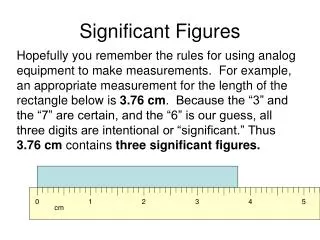
Significant Figures • Scientist use _______________ to determine how _______________ a measurement is. • Significant digits in a measurement include all of the _______________ plus one _______________ .
For example… • Look at the ruler below • What would be the measurement in the correct number of sig figs? • _______________
Let’s try this one • Look at the ruler below • What would be the measurement in the correct number of sig figs? • _______________
The same rules apply with all instruments • The same rules apply • Read to the last digit that you know • Estimate the final digit
Let’s try graduated cylinders • Look at the graduated cylinder below • What would be the measurement in the correct number of sig figs? • _______________
One more graduated cylinder • Look at the cylinder below… • What would be the measurement in the correct number of sig figs? • _______________
Rules for Significant figuresRule #1 • All non zero digits are ALWAYS significant • How many significant digits are in the following numbers? _____________ _____________ _____________ 274 25.632 8.987
Rule #2 • All zeros between significant digits are ALWAYS significant • How many significant digits are in the following numbers? _____________ _____________ _____________ 504 60002 9.077
Rule #3 • All FINAL zeros to the right of the decimal ARE significant • How many significant digits are in the following numbers? 32.0 19.000 105.0020 _____________ _____________ _____________
Rule #4 • All zeros that act as place holders are NOT significant • Another way to say this is: zeros are only significant if they are between significant digits OR are the very final thing at the end of a decimal
0.0002 6.02 x 10²³ 100.000 150000 800 _____________ _____________ _____________ _____________ _____________ For example How many significant digits are in the following numbers?
Rule #5 • All counting numbers and constants have an infinite number of significant digits • For example: 1 hour = 60 minutes 12 inches = 1 foot 24 hours = 1 day There are 30 students in the class
0.0073 100.020 2500 7.90 x 10⁻³ 670.0 0.00001 18.84 _____________ _____________ _____________ _____________ _____________ _____________ _____________ How many significant digits are in the following numbers?
Rules Rounding Significant DigitsRule #1 • If the digit to the immediate right of the last significant digit is less that 5, do not round up the last significant digit. • For example, let’s say you have the number 43.82 and you want 3 significant digits
Rounding Rule #2 • If the digit to the immediate right of the last significant digit is greater that a 5, you round up the last significant figure • Let’s say you have the number 234.87 and you want 4 significant digits
Rounding Rule #3 • If the number to the immediate right of the last significant is a 5, and that 5 is followed by a non zero digit, round up • 78.657 (you want 3 significant digits)
Rounding Rule #4 • If the number to the immediate right of the last significant is a 5, and that 5 is followed by a zero, you look at the last significant digit and make it even. • 2.5350 (want 3 significant digits)
Say you have this number • 2.5250 (want 3 significant digits)
200.99 (want 3 SF) 18.22 (want 2 SF) 135.50 (want 3 SF) 0.00299 (want 1 SF) 98.59 (want 2 SF) _____________ _____________ _____________ _____________ _____________ Let’s try these examples…
Scientific Notation • Scientific notation is used to express very _____________ or very _____________ numbers • I consists of a number between _____________ followed by _____________ to an _____________ • The _____________ can be determined by the number of _____________ you have to move to get only 1 number in front of the decimal
Large Numbers • If the number you start with is greater than 1, the exponent will be _____________ • Write the number 39923 in scientific notation
Small Numbers • If the number you start with is less than 1, the exponent will be _____________ • Write the number 0.0052 in scientific notation
99.343 4000.1 0.000375 0.0234 94577.1 _____________ _____________ _____________ _____________ _____________ Scientific Notation Examples Place the following numbers in scientific notation:
Going from Scientific Notation to Ordinary Notation • You start with the number and move the decimal the same number of spaces as the _____________ . • If the exponent is _____________ , the number will be greater than 1 • If the exponent is _____________ , the number will be less than 1
3 x 10⁶ 6.26x 10⁹ 5 x 10⁻⁴ 8.45 x 10⁻⁷ 2.25 x 10³ _____________ _____________ _____________ _____________ _____________ Going to Ordinary Notation Examples Place the following numbers in ordinary notation: