The Ratification Debate: Federalists vs. Anti-Federalists
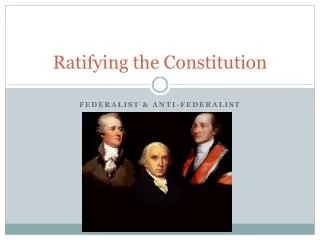
The debate over ratifying the U.S. Constitution saw two key factions: Federalists and Anti-Federalists. The Federalists, including James Madison, Alexander Hamilton, and George Washington, supported the Constitution, arguing that a division of power and checks and balances would prevent tyranny. They wrote The Federalist Papers to persuade the public. Conversely, Anti-Federalists, such as Patrick Henry and Thomas Jefferson, opposed the strong central government and demanded a Bill of Rights to protect individual liberties. This compromise was reached, leading to the Constitution's ratification in 1788 and the Bill of Rights in 1791.

The Ratification Debate: Federalists vs. Anti-Federalists
E N D
Presentation Transcript
Federalists vs. Anti- Federalists • Federalists • Supported the Constitution • Believed division of power and system of checks and balances would keep the national government from becoming tyrannical • Included James Madison, Alexander Hamilton, George Washington and John Jay • Madison, Hamilton, and Jay wrote The Federalist Papers to sway public opinion about the Constitution
Federalists vs. Anti- federalists • Anti- Federalists • Opposed the strong central government created by the Constitution • Believed the Constitution should include a Bill of Rights to protect individual liberties • Included Patrick Henry, Richard Henry Lee, Thomas Jefferson and Samuel Adams • Lee wrote Letters from a Federal Farmer, detailing the problems the Anti- Federalists had with the Constitution
Ratification • Because of strong opposition, the framers of the Constitution agreed to add a Bill of Rights as soon as the Constitution was ratified • The Constitution was ratified in 1788 and the Bill of Rights was ratified in 1791