Solving Radical Equations
In this real-world application, you will learn to solve radical equations to determine the nozzle pressure of antifreeze used for de-icing planes. You work for a commercial airline and need to ensure a flow rate of 250 gallons per minute. This involves calculating the required nozzle pressure for different nozzle diameters: 1.25 inches and 1.75 inches. You'll also explore whether increasing the nozzle diameter by 40% affects the pressure equally. This exercise aligns with Common Core state standards A-REI.1 and A-REI.2.

Solving Radical Equations
E N D
Presentation Transcript
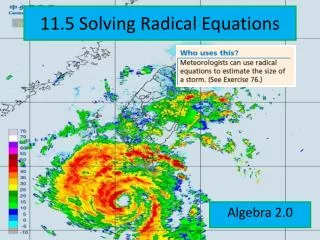
Solving Radical Equations Real-World Application: Finding the nozzle pressure of antifreeze used to de-ice a plane.
Common Core State Standards: • A-REI.1 Explain each step in solving a simple equation as following from the equality of numbers asserted at the previous step, starting from the assumption that the original equation has a solution. Construct a viable argument to justify a solution method. • A-REI.2 Solve simple rational and radical equations in one variable, and give examples showing how extraneous solutions may arise.
Using a Radical ModelYou work for a commercial airline and remove ice from planes. The relationshipamong the flow rate r (in gallons per minute) of the antifreeze for de-icing, thenozzle diameter d (in inches), and the nozzle pressure P (in pounds per squareinch) is shown in the diagram. You want a flow rate of 250 gallons per minute. • Find the nozzle pressure for a nozzle whose diameter is 1.25 inches. • Find the nozzle pressure for a nozzle whose diameter is 1.75 inches. • When you increase the diameter of the nozzle by 40%, do you also change the nozzle pressure by 40%? Explain.