Download
1 / 7
70 likes | 321 Views
DDT (C14H9Cl5) is a white, odorless powder that is not soluble in water but can dissolve in animal fats. Initially used during World War II to combat Typhus by killing lice, it later became a popular pesticide in the USA. However, DDT's persistence in the environment leads to bioaccumulation and biomagnification, impacting various trophic levels. The chemical's ability to leak through cell membranes disrupts electrical impulses, causing serious health issues, including muscle contractions and paralysis. Rachel Carson highlighted these dangers in "Silent Spring."

E N D
DDT Use and Impacts Chapter 30 Mitchell Toolan
What is DDT? • The chemical formula of DDT is C14H9Cl5 • It is a white powder that has little to no odor • DDT is not soluble in water but is soluble in the fats of animals • Like an oil spill, DDT’s can’t be washed out of the environment
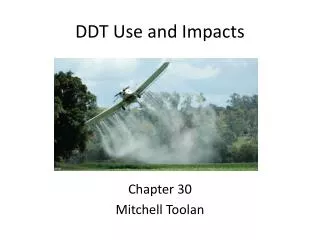
DDT Use • Originally DDT was used in world War Two to prevent the spread of Typhus Fever • It was sprayed on soldiers to kill body lice that spread the disease • After WWII people realized that it could be used as an insecticide • It was then used as a pesticide throughout U.S.A
Impacts of DDTs • Since DDT is insoluble in water it can’t be washed away so it accumulates in the environment • As animals eat the plants it accumulates, or build up, in the animals body • This leads to biomagnification and affects more levels of the trophic levels
Impacts of DDTs • DDTs enter cell membranes and cause them to leak • This leakage stops or slows down electrical impulses throughout the body • When poisoned by DDT, the victim might experience uncontrollable muscle contractions or paralysis. • These symptoms were observed by the scientist Rachel Carson before she wrote the best seller, “Silent Spring”
Works Cited "Dangers of DDT." Chemistry at Duke. Web. 18 Nov. 2011 <http://www.chem.duke.edu/~jds/cruise_ chem/pest/ddtup.html>.