### Understanding the Business Environment: Key Terms and Concepts in Entrepreneurship and Wealth Building ###
This overview details essential concepts in the business environment, focusing on goods, services, and the role of entrepreneurship in wealth creation. It describes tangible products versus intangible services and highlights the definitions of revenue, profit, and loss. The importance of risk management in business and the responsibilities toward various stakeholders are emphasized. Additionally, it discusses the government's role in promoting business, the impact of global competition, and critical thinking in entrepreneurship. Start your journey in understanding and thriving in the business landscape! ###

### Understanding the Business Environment: Key Terms and Concepts in Entrepreneurship and Wealth Building ###
E N D
Presentation Transcript
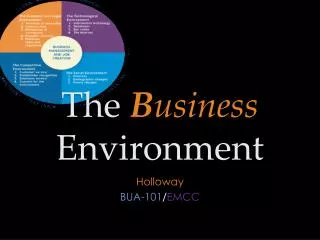
The Business Environment Holloway BUA-101/EMCC
Entrepreneurship and Wealth Building GOODS and SERVICES Terms you need to know… • Goods -- Tangible products such as computers, food, clothing, cars and appliances. • Services -- Intangible products (that can’t be held in your hand) like education, healthcare, insurance, recreation and travel. • Successfully filling a market need means you could make money for yourself and provide jobs for others. 1-2
Entrepreneurship and Wealth Building BUSINESS and ENTREPRENEURSHIP Terms you need to know… • Business -- Any activity that seeks to provide goods and services to others while operating at a profit. • Entrepreneur-- A person who risks time and money to start and manage a business. • Success in business is often based on the strategy of finding a need and filling it. 1-3
Revenues, Profits and Losses REVENUE, PROFIT AND LOSS Terms you need to know… • Revenue -- The total amount of money a business takes in during a given period by selling goods and services. • Profit -- The amount of money a business earns above and beyond what it spends for salaries and other expenses. • Loss -- Occurs when a business’s expenses are more than its revenues. 1-4
Matching Risk with Profit RISK Terms you need to know… • Risk -- The chance an entrepreneur takes of losing time and money on a business that may not prove profitable. • Not all businesses make the same amount of profit. • Businesses take risks, but with great risks could come great profit. 1-5
Businesses Add to the Standard of Living and Quality of Life HOW is TAX MONEY USED? Taxes: Are they Good or Bad??? Taxes are used to provide: What the heck are taxes for? • Hospitals • Schools • Libraries • Playgrounds • Roads • Fire Protection • Police Protection • Environmental Programs • Support for People in Need 1-7
Responding to the Various Business Stakeholders STAKEHOLDERS • Stakeholders -- All the people who stand to gain or lose by the policies and activities of a business and whose concerns the businesses need to address. • Who are Stakeholders? • Customers • Employees • Stockholders • Suppliers • Dealers • Community Members • Media • Elected Officials • Bankers • Environmentalists 1-8
Entrepreneurship Versus Working for Others THE UPS and DOWNS of ENTREPRENEURSHIP • The UPS • The freedom to succeed. • Make your own decisions. • High possibility of wealth. • Hire your own staff. The DOWNS The freedom to fail. No paid vacations. No health insurance. No daycare. 1-10
Opportunities for Entrepreneurs WHO TAKES the ENTREPRENEURIAL CHALLENGE? • Millions of people have started businesses and succeeded. • The number of Hispanic-owned businesses in the U.S. has grown dramatically. • Women now own one-third of all businesses. 1-11
The Importance of Entrepreneurs to the Creation of Wealth FIVE FACTORS of PRODUCTION • Land • Labor • Capital • Entrepreneurship • Knowledge • Entrepreneurs use what they’ve learned to grow their businesses and increase wealth. 1-12
The Business Environment WHAT is theBUSINESS ENVIRONMENT? 1-13
Global Environment • Economic and Legal Environment • Technological Environment • Competitive Environment • Social Environment Pg. 12-19
The Business Environment GOVERNMENT’S ROLE in BUSINESS Government can promote business by… Minimizing spending and keeping taxes and regulations to a minimum. Allowing private ownership of businesses. Minimizing interference with the free exchange of goods and services. Passing laws that enable businesspeople to write enforceable contracts. Establishing a currency that’s tradable in world markets. Minimizing corruption. 1-15
The Global Environment IMPORTANT CHANGES to the GLOBAL ENVIRONMENT • Growth of global competition. • Increase of free trade among nations. • Development of efficient distribution systems. • Advances in communication systems. 1-16
The Global Environment INCREASING COSTS of the GLOBAL ENVIRONMENT LG7 • Wars, like those in Iraq and Afghanistan, cost billions of dollars. • Tax money is diverted. • Cost of security goes up. • Cost of insurance goes up. 1-17
Critical Thinking • Let’s start a restaurant here in Bangor… • Who are our stakeholders? • How can we benefit our community (aside from just providing jobs and tax revenue)? • Who are your suppliers? How will you create good relationships with them? • Is there any conflict between our desire to be as profitable as possible and our desire to pay employees a livable wage? • Which environmental factors may have the biggest impact on our business? How? Why?
Choose a Business… anybusiness! • Walk in like you own the place… and look around. • Answer the questions as they regard that business. • Take a few notes and bring’em to our next meeting.