Download

1 / 3
30 likes | 169 Views
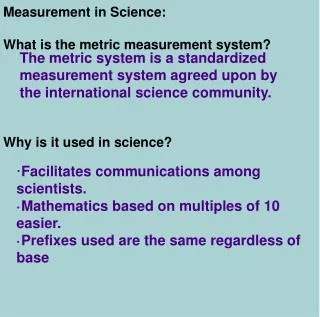
Explore the metric system's prefixes and learn how to convert units easily in science. This guide explains the meanings of prefixes like kilo- (1000x), hecto- (100x), deka- (10x), deci- (0.1x), centi- (0.01x), and milli- (0.001x). With practical examples, such as converting 325 cm to mm, you can master unit conversion by simply adjusting decimal places. Gain confidence in your measurements and scientific calculations by understanding how to manipulate fractions and equations for effective unit conversions.

E N D
Measurement in Science rinking K ing enry ied y D hocolate ilk H D B C M K is for Kilo- and means one thousand times (1000x) H is for Hecto- and means one hundred times (100x) D is for Deka (Da) – and means ten times (10x) B is for the base unit (meter-m; liter-l; gram-g) D is for deci (d) – and means one-tenth (0.1x) C is for centi (c) – and means one one-hundreth (0.01x) M is for milli (m) – and means one one-thousandth (0.001x)
Measurement in Science To convert between units of the Metric System it is as easy as moving the decimal. 325 cm = ?mm The prefix milli- is one place to the right, so you will add one zero to the number 1 for the top of the fraction. Which unit in the fraction is furthest to the left? It gets a value of 1 in the fraction. Start with what you are given, and write an equation: Draw a multiplication sign and fraction bar: Put the units to get rid of in the bottom of the fraction: And the desired units on top: How do you solve the equation? 10 mm 325 cm = 3,250 mm X _________________ 1 cm K H Da B d c m