Enhancing Fuel Efficiency: The Advantages of E30 Ethanol Blends
This presentation explores the benefits of using E30 ethanol blends as a high-efficiency fuel alternative. By providing over 100 octane performance and equal or better mileage potential compared to standard blends, E30 offers significant savings for consumers at the pump. The analysis includes how E30 can extend gasoline efficiency and examines its impact on automotive technology. Engineers can leverage the high octane of E30 to develop advanced fuel systems, yielding a cleaner, more efficient energy source while breaking the blend wall of traditional fuels.

Enhancing Fuel Efficiency: The Advantages of E30 Ethanol Blends
E N D
Presentation Transcript
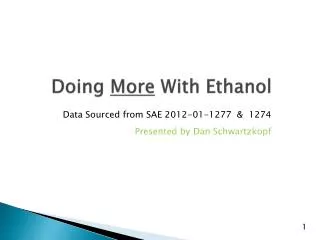
Doing More With Ethanol Data Sourced from SAE 2012-01-1277 & 1274 Presented by Dan Schwartzkopf 1
How to Improve Efficiency Phase I Ethanol Extends the Efficiency of Gasoline 2
Reaching the Octane Limit / Knock Phase I WOW, E30 Provides Over 100 Octane Performance 3
Equal or Better Mileage Potential with E30 Most fuel today has 10% ethanol blended, even FFVs on the road today would see little to no MPG loss with E20 or E30 when operating at a higher load. Thus, saving consumers money at the pump. Phase I There is a Modest Value Today of Intermediate Blends 4
More Efficiency Improvement Value Vertically and Horizontally 7
100 RON E30 Breaking the Blend Wall with a Clean, High Efficiency Fuel Column Arepresents what the consumer will see for current octane, but column C will be the additional value of having 30% ethanol. Column B is what automobile engineers will look at, but if E30 is widely adopted, then they can plan on adding column C to B for direct injection fuel systems. Column C would be reduced by at least 50% for current port fuel injection vehicles. RON = Research Octane Number 6