Harmonics Analysis in Control Systems: Impacts of VSI and Motors
This analysis explores the origins and effects of harmonics in voltage source inverters (VSIs) and motors. It addresses the importance of understanding thermal and acoustic noise, especially in fast switching frequency scenarios. Non-linear loads and third harmonic considerations are examined, emphasizing their influence on filter design. Various filtering approaches, including Dv/Dt filters and passive sinusoidal filters, are discussed, focusing on their advantages and limitations. Additionally, the paper highlights the potential risks associated with harmonic distortion, including thermal stress and isolation challenges in modern motors.

Harmonics Analysis in Control Systems: Impacts of VSI and Motors
E N D
Presentation Transcript
Harmonics Analysis in Control System Limei Zhao 06/06/03
Origin of Noise • DSP part • Fast switching frequency • Voltage Source Inverter • Thermal noise • Dv/Dt effects • LPF • Thermal loss • Motor • EM interaction • Acoustic interaction
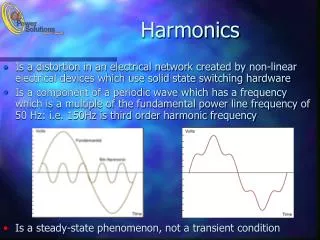
DSP Part Harmonics t Domain ω Domain • Electrical frequency harmonics • Space vector pwm algorithm • Modulated Signal m(t)= sine wave + 3rd Harmonic • Non Linear Load • VSI • PMSM (oscillations but assume none) • Switching Frequency Harmonics • Switching function s(m,c) • PWM • Pulse of same amplitude but different width 1 2 3
Generally, 3rd harmonics is thought unharmful to three phase systems • But the results show that 3rd harmonic still need to be considered when designing a filter The signal is before VSI
VSI Harmonics Analysis • VSI generated harmonic are of following orders n = p* k ± 1, where k = 1, 2, 3, …; p is the number of pulse • The harmonic currents rms value for 6-pulse Hn = H1/n
LPF Part • Power dissipation on filter passive components • It is important to find balance value of L or C to get both • good LPF and less power dissipation
Prolong rise time of inverter output voltage pulses Over voltage is decreased Switching losses are decreased Some Useful Filter(1) --- Dv/Dt Filter (Soft Switching)
Advantages Simple and Reliable Inexpensive Disadvantages Limited effectiveness Line drop Advantages Simple and reliable For tune frequency: THDI<5% Increase in the input power factor due to capacitive current Disadvantages Limited spectrum Some Useful Filter(2)--- Passive Sinusoidal Filter L Filter LC Filter
Motor Part • Power transfer are sources of harmonics • Because Magnetic materials are operated very close and in non-linear region • The transfer magnetising current will be non-sinusoidal and containing harmonics (mainly 3rd ) even if the applied voltage are sinusoidal • Rotating machines are sources of harmonics • The winding can never be exactly sinusoidally distributed so that MMF is distroted • Coil spanning in 3-phase machine can be used to reduce 5th and 7th harmonics • 3-phase machines can block 3rd harmonic current at some extent • Harmonics produced are considered negligible compared to those produced by other sources
Current & Voltage to Motor Red is phase to phase voltage ; Green is phase current @ about 60KRPM with LPF(L=150uH)
The Effects of Harmonic Distortion • Thermal stress • With strong cool air, motor current are obviously better • Heat sink • Unstable • Insulation stress • Especially for new motor’s much high current • Load disruption