Download
1 / 16
170 likes | 284 Views
Explore the recent intron gains in Caenorhabditis species, mechanisms behind the phenomenon, and functions of genes with new introns. Learn about reverse-splicing, tandem duplication, and more.

E N D
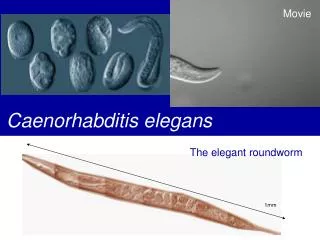
Origins of recently gained introns in Caenorhabditis Avril Coghlan and Kenneth H. Wolfe Department of Genetics, Trinity College Dublin, Ireland
Rate of intron gain and loss • Over the long term, losses and gains occurred at high rates in eukaryotes • Over the short term, losses are more frequent than gains
Recent intron gains • mosquito TPI gene • fly XDH gene • midge globin genes • plant catalase gene • worm chemoreceptor genes
Intron gain in nematodes • 4400 C. elegans- and 2200 C. briggsae-specific introns • 0.005 gains/losses per gene per My in nematodes
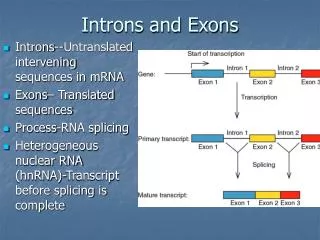
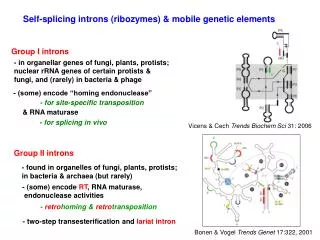
Mechanism of intron gain • Insertion of a transposon (Crick 1979) • Reverse-splicing of a pre-existing intron (Sharp 1985) translation splicing mRNA reverse- splicing genome cDNA
Mechanism of intron gain • Tandem duplication of an exon fragment containing AGGT (Rogers 1989) AGGT AGGT AGGT AG GT
Germline expression • 63% of C. elegans genes that gained introns are expressed in the germline, compared to 42% of control genes (P = 0.001) it is unlikely that introns originate by partial exon duplication
Mechanism of intron gain • Tandem duplication of an exon fragment containing AGGT • Reverse-splicing of a pre-existing intron • Insertion of a transposon
Repeat elements in introns
Functions of genes that gained introns Several genes with novel introns code for proteins involved in splicing/surveillance: smg-2 homolog of yeast Dbp2 homolog of yeast Cdc40 homologs of yeast Hsh155, Prp6, Prp19 homologs of yeast Imd2 and Ssa1 homolog of yeast Dis3 homolog of human CPSF5
Reverse-splicing in genes involved in splicing • autoregulatory loops • incorporation in the spliceosome of a protein still joined to its mRNA
Conclusions • some gains are due to reverse-splicing • introns gained by reverse-splicing are copies of introns from the same gene • reverse-splicing is especially frequent in genes involved in splicing
Acknowledgements • Science Foundation Ireland for funding • TIGR for use of B. malayi sequence • Richard Durbin and Lincoln Stein for use of C. briggsae sequence