Electrolyte Abnormalities
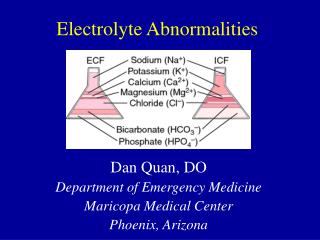
Electrolyte Abnormalities. Dan Quan, DO Department of Emergency Medicine Maricopa Medical Center Phoenix, Arizona. Electrolyte Abnormalities That May Cause Life Threatening Conditions. Potassium Disorders Magnesium Disorders Sodium Disorders. Potassium.

Electrolyte Abnormalities
E N D
Presentation Transcript
Electrolyte Abnormalities Dan Quan, DO Department of Emergency Medicine Maricopa Medical Center Phoenix, Arizona
Electrolyte Abnormalities That May Cause Life Threatening Conditions • Potassium Disorders • Magnesium Disorders • Sodium Disorders
Potassium • Most potassium regulation is done by the kidney (95%) • Most abundant intracellular cation
Hyperkalemia • Effects • Depolarizes the cell membrane • Slow ventricular conduction • Decreases action potential duration
Hyperkalemia Electrocardiogram • Normal sinus rhythm • Peaked T waves • Wide QRS • Loss of P waves • Sine wave, ventricular fibrillation, asystole • RBBB, LBBB, heart blocks Lack of EKG changes in the setting of hyperkalemia does not mean treatment should not be initiated
Hyperkalemia Immediate Treatment = IV Calcium • Peripheral IV: 1 ampule calcium gluconate (93 mg) • Central lines: 1 ampule calcium chloride (360 mg) • Stabilizes the excited myocardium by decreasing the resting membrane potential • Onset of action < 3 minutes, Duration of action 30-60 minutes, may repeat in 5 minutes if no effect seen • Infuse IV over 10 minutes • May be given empirically in most cases
HyperkalemiaPushin’ It Back (Into the cell) • IV glucose and insulin • Glucose is given to prevent hypoglycemia • 1 amp (25 g) dextrose 50% (D50) • Regular insulin 10 units IV push • Onset is 20 minutes, Duration of action 30-60 minutes • Albuterol nebulizer treatment • 20 mg over 10 min (decreases K+ by 1 mEq/L) • Onset is 30 minutes, Duration of action 2 hours • Albuterol MDI delivers 90 mcg per spray
HyperkalemiaHey, What About Sodium Bicarb? • Sodium bicarbonate in bolus doses does not decrease potassium in dialysis patients • Does not shift potassium back into the cell • Only after a 4 hour infusion did it decrease potassium by 0.6 mEq/L • May still be useful in those with a metabolic acidosis
HyperkalemiaGettin’ It Out • Furosemide 40–80 mg IV • Onset of action 15 minutes, Duration of action 2–3 hours • Sodium polystyrene sulfonate (Kayexalate) 15–30 g • Onset 2 hours, Duration of action 4–6 hours • No good evidence this does much • Hemodialysis • Onset immediate once it is initiated, Duration of action 3 hours • Removes about 1.5 mEq/L/hour
Hyperkalemia • Cardiac monitor or Serial EKGs for cardiac abnormalities • Lab draw after 1 to 2 hours after therapy initiated to assess treatment progress • May require further intervention
Hypokalemia • Most common causes of hypoK+ are: • GI losses • Diuretic use • Hypomagnesemia • Life threatening emergencies associated with hypoK+ • Diaphragmatic weakness, rhabdomyolysis, and cardiac dysrhythmias (highest risk is a rapid drop to 2.5 mEq/L)
Does Hypomagnesemia Contribute? • Magnesium is a “channel closer” in kidney cells • Acts on the Na+/K+ ATPase as a cofactor • Low magnesium “opens” the channel causing potassium loss through urinary excretion • Replacing potassium without replacing magnesium may be futile (refractory hypokalemia)
Potassium Oral Dosing • In general: 10 mEq KCl raises plasma K+ 0.1 mEq/L • Readily absorbed by the GI tract • Immediate release preparations liquid KCl • No evidence for > 50 mEq in a single dose • Do not use extended release KCl (K-Dur) if immediate results are required • Avoid giving > 20 mEq in a single dose (administer every 2 hours) • Increases risk of GI bleeding
Potassium Intravenous Dosing • Infuse potassium chloride at no more than 10 to 20 mEq/hour • Higher rates should be given through a central line • Rates > 80 mEq/hour are associated with dysrhythmias
Magnesium • Where is magnesium located in the body? • 53% bone • 27% muscle • 19% soft tissue • 0.5% RBCs • 0.3% serum • The only way we can assess magnesium levels • Kidney is involved in regulation
Hypomagnesemia • Cardiovascular • Seen as prolonged PR and QT intervals on EKG • Also can cause SVT, PAC, PVC, atrial abnormalities including atrial fibrillation, junctional rhythms, ventricular tachycardia and fibrillation, torsades de pointes
Hypomagnesemia • Consider treatment in these patients • Alcoholics • Asthmatics • Stroke patients • Cardiac patients • Dysrhymias, MI, CHF with dysrhymias • Pregnant patients (preeclampsia) • Hypocalcemia or Hypokalemia • Neurologic problems – vertigo, ataxia, tremor fasciculation, seizures
HypomagnesemiaReplacement • Magnesium sulfate • 1 g is equivalent to 8 mEq of elemental Mg2+ • Maximum infusion rate is 7 minutes/gram • Faster infusion rates cause ventricular dysrhythmias • Oral replacement: Do not exceed 40 mEq of elemental Mg2+ (diarrhea) • Magnesium oxide • 400 mg is equivalent to 20 mEq of elemental Mg2+ • Severe hypomagnesmia replace 48 mEq over 24 hrs
HypomagnesemiaSpecific Recommendations • Seizures or an acute dysrhythmia • 8 to 16 mEq Mg2+ (MgSO4 1-2 g) IV over 5 to 10 minutes • Torsades de pointes • Advanced Cardiac Life Support Guidelines • Loading dose of 16 mEq Mg2+ (MgSO4 2 g) IV over 15 minutes • Then 8 mEq/hour (MgSO4 2 g/hour) • Preeclampsia • 32 mEq (MgSO4 4 g) then 8 mEq/hour (MgSO4 2 g/hour)
Hypermagnesemia • Occurs in renal impaired patients or iatragenic administration • 3 to 4 mEq/L • Hypotension, flushing, nausea, mental status change, hyporeflexia • 5 to 6 mEq/L • QRS widening, QT and PR prolongation, conduction abnormalities • 8 to 10 mEq/L • Severe muscle weakness, respiratory depression, cardiac arrest
Hypermagnesemia Treatment • Calcium 100 to 200 mg over 5-10 minutes IV • e.g. 1 amp calcium gluconate minimum • May require bolus dosing or continuous infusion (2–4 mg/kg/hr)
Hyponatremia • Many causes of hyponatremia • [Na+] < 125 mEq/L are associated with neurologic problems • Cerebral edema • Increased intracranial pressure (encephalopathy) • Seizures
Hyponatremia Management • Rapid correction is dangerous • Acute hyponatremia • More symptomatic • Can tolerate rapid correction • Corrected 1 to 2 mEq/L/hour • Chronic hyponatremia • Correct at 0.5 mEq/L/hour • Risk of central pontine myelinolysis
Central Pontine Myelinolysis • Demyelinating process of the pons • Appears 1 to 6 days after treatment and beyond • May be irreversible • Causes locked-in syndrome • Complete paralysis except for eye control • Mind functions normally
Emergent Treatment of Hyponatremia3% (Hypertonic) Saline • Treatment for any hyponatremia induced neurologic process • 100 mL bolus • Repeat in 30 minutes if no improvement • Raises [Na+] by 2 to 4 mEq/L • Avoid hypertonic saline drips
Hypokalemia Treatment Summary • KCl 10 mEq raises K+ by 1 mEq/L • Avoid slow release oral potassium when immediate absorption is required • Limit to 20 mEq per dose every 2 hours • No IV bolus K+ infusions! • Replace magnesium with potassium even when magnesium is normal
Hypomagnesemia Treatment Summary • Serum levels may not reflect total magnesium body stores and deficiency • For seizures, Torsades de Pointes • 8 to 16 mEq Mg2+ (MgSO4 1-2 g) IV • Preeclampsia and eclampsia • 32 mEq Mg2+ (MgSO4 4 g) IV
http://lalainern.tumblr.com/post/23640268629/nurse-with-a-smile-hypermagnesemia-riskhttp://lalainern.tumblr.com/post/23640268629/nurse-with-a-smile-hypermagnesemia-risk
Hyponatremia Treatment Summary • Treat hyponatremia with severe neurologic symptoms with hypertonic saline (3%) • 100 mL IV over 10 minutes • Avoid rapid correction • Central pontine myelinolysis
References • Riccardi A, Tasso F, Corti L, Panariello M, Lerza R. The emergency physician and the prompt management of severe hyperkalemia. Intern Emerg Med. 2012 Jul 29. • Weisberg LS. Management of severe hyperkalemia. Crit Care Med. 2008 Dec;36(12):3246-51. • Huang CL, Kuo E. Mechanism of hypokalemia in magnesium deficiency. J Am Soc Nephrol. 2007 Oct;18(10):2649-52. • Mount DB, Zandi-Nejad K. Disorders of Potassium Balance. Brenner and Rector's The Kidney 9th ed. • Tong GM, Rude RK. Magnesium deficiency in critical illness. J Intensive Care Med. 2005 Jan-Feb;20(1):3-17. • http://www.globalrph.com/magnesium_supplements.htm accessed 8/28/12 • Rosen’s Emergency Medicine • Francis GS. Cardiac complications in the intensive care unit. Clin Chest Med. 1999 Jun;20(2):269-85. • Taal: Brenner and Rector's The Kidney, 9th ed.