Download

1 / 8
80 likes | 219 Views
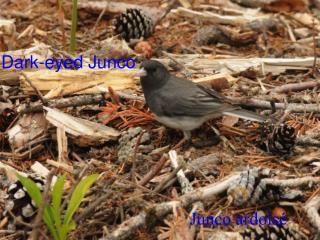
The Dark-Eyed Junco is a medium-sized sparrow characterized by its rounded head, short stout bill, and long tail. They breed in North American forests at various elevations and thrive in diverse habitats, including open woodlands and gardens during migration. Primarily seed-eaters, they also consume insects during the breeding season. Nesting involves females weaving materials to build nests containing 3-6 eggs. Notably, the oldest recorded junco lived over 11 years, with a population estimate of around 630 million individuals.

E N D
Black Eyed Junco( junco hyemails) By Zack Neve & Moussa Diao
Size and Shape • The Dark Eyed Junco is a medium sized sparrow with a rounded head. • Short, Stout bill and a fairly long, conspicuous tail.
Habitat • Dark eyed Juncos breed in forests across much of North America, and at elevations ranging from sea level to 11,000 feet. • Often found in coniferous forests including pine, aspen, cottonwood, oak , maple, and hickory. • During winter and on migration they tent to use a wider variety of habitats including open woodlands, fields, roadsides, parks, and gardens
Food Dark- eyed Juncos are primarily seed- eaters, with seeds of chickweed, buckwheat, and sorrel. At feeders they seem to prefer millet over sunflower seeds. During the breeding season, Dark- Eyed Juncos also eat insects including beetles, moths, butterflies, caterpillars, ants, wasps, and flies. They fly up from the ground to catch insects from tree trunks.
Nesting • Females build the nests, using her beak to weave together materials and her body to give the nest its shape. • Clutch Size 3-6 eggs • Nesting Period- 10-13 days • Egg description white, gray, pale bluish white, or pale greenish white speckled with brown. Occasionally unmarked.
Juncos that breed in Canada and Alaska migrate to the southern United States in the winter. Migration
Fun Facts ! • The oldest recorded Dark- Eyed Junco was 11 years 4 months old. • A recent estimate set the junco’s total population at approximately 630 million individuals.
Citations • TheCornelllab of ornithlogy (all aboutbirds.org) • eBird.org