Download
1 / 22
220 likes | 349 Views
Explore the diverse colonial identities that emerged in New England, the Middle Colonies, and the Southern Colonies. Discover the motivations behind the Pilgrims' migration to Massachusetts, the Puritan values that shaped New England societies, and the religious tolerance embraced by Quakers in Pennsylvania. Learn about the agricultural focus of the Southern Colonies and their reliance on cash crops and plantation economies. Each region's unique environmental factors and social structures contributed to the development of distinctly American identities in the early colonial period.

E N D
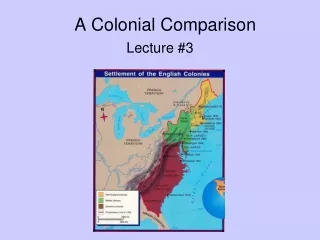
Development of a Colonial Identity New England, Middle, and Southern Colonies
New England Colonies • Massachusetts • New Hampshire • Connecticut • Rhode Island
Plymouth, Massachusetts • Why did the Pilgrims migrate to America? • The Pilgrims migrated to North America to escape religious persecution
New England Colonies Environment • Harsh Winters • Good Harbors • Fishing • Whaling Trade • Jagged Coastlines • Rocky Soil
New EnglandColonies • Puritans who lives centered around the church • Religious freedom vs Religious toleration
New England Colonies • New England Villages • Skilled Craftsmen • Shopkeepers
Middle Colonies • New York • Pennsylvania • New Jersey • Delaware
Middle Colonies • Quakers who believed in a simple lifestyle and that all people are EQUAL • They refused to bow before the King, fight in wars, or pay taxes to the Church of England
Middle Colonies • Quakers • Religious diversity- there were many different religions in the Middle Colonies
Pennsylvania • William Penn the founder of Pennsylvania believed in religious freedom. • William Penn was a Quaker
Middle Colonies • Market towns • Villages and towns • Skilled and unskilled workers • Fishermen
Middle Colonies • Moderate climate • Coastal lowlands • Wide and deep rivers • Rich farmland • Grain farming • Livestock raising
Southern Colonies • Maryland • Virginia • North Carolina • South Carolina • Georgia
Southern Colonies Region • Long growing season • Cash crops • Plantations • Small farms • Humid climate
Southern Colonies • Good harbors and rivers made it easy to export their cash crops. • The cash crops in the early Southern Colonies was rice, indigo, and tobacco.
Jamestown, Virginia 1607 • In 1607, a group of wealthy English gentlemen merchants formed the Virginia Company. There goal was an economic venture designed to find goal in the new land.
Southern way of life • Church of England • Few Schools • Few Cities
Plantation Agriculture Slave labor Indentured servants Large cash crops Mansions
Southern Lifestyle • Colonial Williamsburg, Virginia
Slavery in the South • Plantation owners relied on slaves and indentured servants to sow and harvest their fields.