Download
1 / 4
40 likes | 152 Views
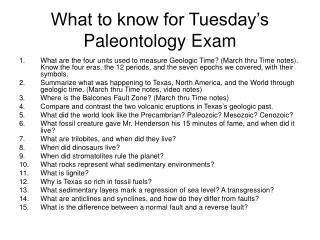
What to know for Tuesday’s Paleontology Exam. What are the four units used to measure Geologic Time? (March thru Time notes). Know the four eras, the 12 periods, and the seven epochs we covered, with their symbols.

E N D
What to know for Tuesday’s Paleontology Exam • What are the four units used to measure Geologic Time? (March thru Time notes). Know the four eras, the 12 periods, and the seven epochs we covered, with their symbols. • Summarize what was happening to Texas, North America, and the World through geologic time. (March thru Time notes, video notes) • Where is the Balcones Fault Zone? (March thru Time notes) • Compare and contrast the two volcanic eruptions in Texas’s geologic past. • What did the world look like the Precambrian? Paleozoic? Mesozoic? Cenozoic? • What fossil creature gave Mr. Henderson his 15 minutes of fame, and when did it live? • What are trilobites, and when did they live? • When did dinosaurs live? • When did stromatolites rule the planet? • What rocks represent what sedimentary environments? • What is lignite? • Why is Texas so rich in fossil fuels? • What sedimentary layers mark a regression of sea level? A transgression? • What are anticlines and synclines, and how do they differ from faults? • What is the difference between a normal fault and a reverse fault?
Geologic Map – North America As a generalization, red refers to exposed Precambrian rocks, purple to Lower Paleozoic, blue to Upper Paleozoic, greens to Mesozoic rocks, yellows to Cenozoic; and buffs to Pleistocene rocks.
Geologic Map - Texas Dark red (Central)– Precambrian Blue – Early Pz Gray – Late Pz Dark red (Panhandle) – early Mz Green – late Mz Orange/Olive/Brown – early Cz Bright Red (West) – early Cz volcanics Bright Red (East) – early Cz sediments Yellow – Q
Balcones Fault Zone Llano Uplift El Paisano Volcano Pilot Knob/Knippa Volcanoes East Texas & Gulf Coast Salt Domes Structures to be aware of